
Conveyor
Stable material flow is one of the foundations of an efficient production line. When parts, trays, pallets, or finished goods need to move between workstations with consistent timing and minimal manual handling, a conveyor becomes a practical part of the automation architecture. In assembly and inspection environments, conveyors help connect separate processes into a more controlled and repeatable workflow.
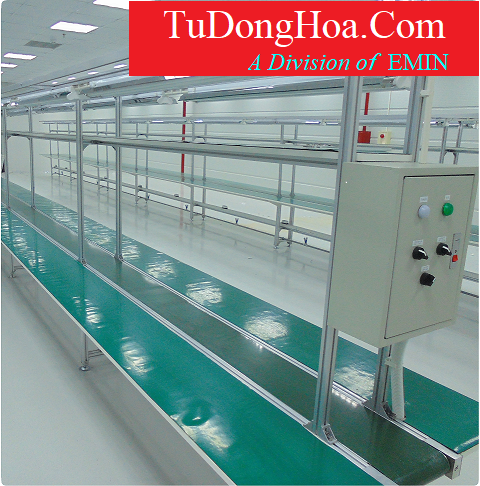
On this page, you can explore conveyor solutions used in industrial assembly and inspection lines, where transport is not just about moving items from one point to another, but also about supporting positioning, buffering, inspection, and line balancing. The right layout can improve throughput, reduce operator intervention, and make the overall system easier to expand or integrate with other automated equipment.
The role of conveyors in assembly and inspection systems
In a manufacturing setting, conveyors do more than provide basic transport. They often act as the link between manual stations, robotic handling, test cells, and quality checkpoints. This is especially important in lines where process timing, product orientation, and transfer stability directly affect inspection accuracy and assembly consistency.
A well-planned conveyor system can support continuous flow, temporary accumulation, or indexed movement depending on the production objective. In many projects, the conveyor is designed as part of a wider line concept together with automatic workpiece feeding systems and downstream handling stations, helping manufacturers reduce idle time between operations.
Where conveyor systems are commonly used
Conveyors are widely applied in lines that require repeatable transfer of components, subassemblies, and finished units between defined process steps. Typical examples include product assembly, visual checks, electrical testing, labeling, sorting, packaging support, and transfer to palletizing or storage areas. In these situations, movement must remain stable enough to protect parts while still meeting line speed requirements.
Within inspection-oriented environments, conveyors are also used to bring products into a controlled viewing or test position. When integrated with a vision inspection system, they can help present items consistently for image capture, defect detection, code reading, or presence verification. This makes the conveyor not just a transport device, but an important element in process control.
Key selection factors for a conveyor solution
Choosing a conveyor for an industrial line usually starts with the product itself. Size, weight, shape, surface condition, and orientation requirements all influence the transfer method. A compact electronic assembly may need smooth and precise handling, while heavier mechanical parts may require more robust structure and different transfer mechanics.
Another important factor is the required line behavior. Some processes benefit from uninterrupted product flow, while others need stop-and-go indexing for assembly, testing, or operator interaction. Engineers also review available floor space, integration with sensors and actuators, maintenance accessibility, and how the conveyor will communicate with the wider control system. These practical details often determine whether the result is simply workable or truly efficient.
Integration with automated production lines
Conveyors deliver the most value when they are considered part of the overall automation strategy rather than as isolated hardware. In many projects, they are combined with feeders, pick-and-place units, inspection stations, marking equipment, reject mechanisms, and operator workstations. This allows product movement to match the logic of the process instead of forcing the process to adapt to a generic transport method.
For higher-volume applications, conveyors may also be incorporated into broader line concepts such as automated automobile production line solutions, where synchronized transfer supports assembly sequencing, inspection checkpoints, and material handoff across multiple stages. In these environments, system integration is often just as important as the conveyor mechanics themselves.
Benefits of a well-designed conveyor layout
A suitable conveyor layout can improve production stability in several ways. It helps standardize material transfer, reduces unnecessary manual carrying, and lowers the chance of product mix-up between stations. It can also support cleaner workstation organization by defining clear infeed, processing, and outfeed paths.
From an operational perspective, conveyors can contribute to better line balance by controlling how products arrive at each station. This is useful when some tasks require buffering and others require steady takt-based flow. Over time, these improvements can make troubleshooting easier and support future upgrades without redesigning the entire line from the ground up.
Conveyors in inspection and test workflows
Inspection lines often place additional demands on transfer equipment. Products may need to pause at exact positions, maintain orientation, or move at a controlled speed past cameras, probes, or sensors. In this context, conveyor design affects the repeatability of inspection results as much as it affects throughput.
For electronics or board-level testing environments, manufacturers may also use related solutions such as a flying probe tester alongside conveyorized handling concepts, depending on the production stage and inspection method. The key point is that transport and testing should work together as one process, not as disconnected steps.
Planning for reliability, maintenance, and expansion
In B2B manufacturing projects, equipment decisions are rarely based on movement alone. Reliability over long operating hours, ease of maintenance, spare part accessibility, and future line modification are all relevant when selecting a conveyor system. Even a simple transfer section can become a bottleneck if cleaning, adjustment, or service access is overlooked.
It is also useful to think ahead about product changes and capacity growth. A conveyor that fits the current process but cannot adapt to new fixtures, additional inspection stations, or altered routing may limit future expansion. For that reason, many buyers evaluate not only present requirements but also how the conveyor will support scalable automation over time.
Choosing the right conveyor for your process
The most suitable conveyor depends on how materials move through your actual production sequence, not just on transport distance. A good selection process considers product characteristics, cycle time, station interaction, inspection requirements, and the level of automation expected across the line. When these elements are aligned, the conveyor becomes a reliable backbone for consistent production flow.
Whether the goal is to connect assembly stations, support in-line inspection, or build a more integrated transfer path within an automated system, a carefully planned conveyor solution can improve both efficiency and process control. Reviewing the line as a whole is usually the best starting point for identifying the right configuration for long-term industrial use.
-
-
-
-
-
-
-
-
-
-
-
-
-
-
-
-
-
-
-
-
-
-
-
-