

Selective Conformal Coating Machines
When PCB assemblies need reliable protection against humidity, dust, chemicals, and temperature variation, process consistency becomes just as important as the coating material itself. In high-mix and quality-focused electronics production, Selective Conformal Coating Machines help manufacturers apply coating only where it is needed, with better repeatability than manual methods and with less risk of overspray on keep-out areas.
For production teams looking to improve throughput, reduce operator dependency, and standardize coating quality, this category supports a more controlled approach to board protection within modern assembly and inspection environments.
Why selective coating matters in electronics manufacturing
Conformal coating is widely used to protect printed circuit assemblies in demanding operating conditions. The challenge is that many boards contain connectors, test points, heat-sensitive components, or other zones that should not be coated. A selective process allows material to be deposited accurately on target areas while avoiding unnecessary masking and rework.
This is especially useful for manufacturers handling industrial electronics, automotive-related assemblies, control boards, and other products where process repeatability and traceable production steps are important. Compared with manual application, automated coating systems can help improve uniformity from board to board and support more stable production planning.
How these machines fit into an automated line
Selective conformal coating equipment is not an isolated process. In many factories, it forms part of a broader assembly flow that may include handling, transfer, inspection, and downstream verification. Integration with a conveyor system helps move boards through the coating stage in a controlled and repeatable way, especially where line balancing and operator efficiency are priorities.
Inspection also remains a key part of coating quality control. Depending on the process strategy, manufacturers may combine coating with visual verification and pattern checks using a vision inspection system to confirm coverage, alignment, and protected areas before boards proceed to the next stage.
Typical capabilities to evaluate
Not every selective coating setup is the same, so it is useful to compare machines by how well they match the actual board design, coating chemistry, and production volume. Important considerations usually include motion accuracy, nozzle flexibility, usable coating area, conveyor compatibility, and the ability to support different spray or dispense patterns.
For many users, the practical goal is to balance precision application with line productivity. Features such as multiple nozzle options, controlled motion across X, Y, and Z axes, board clamping, and material handling functions can make a meaningful difference in daily operation. Where traceability or product variation is high, options such as code scanning or vision support may also be relevant.
Representative equipment in this category
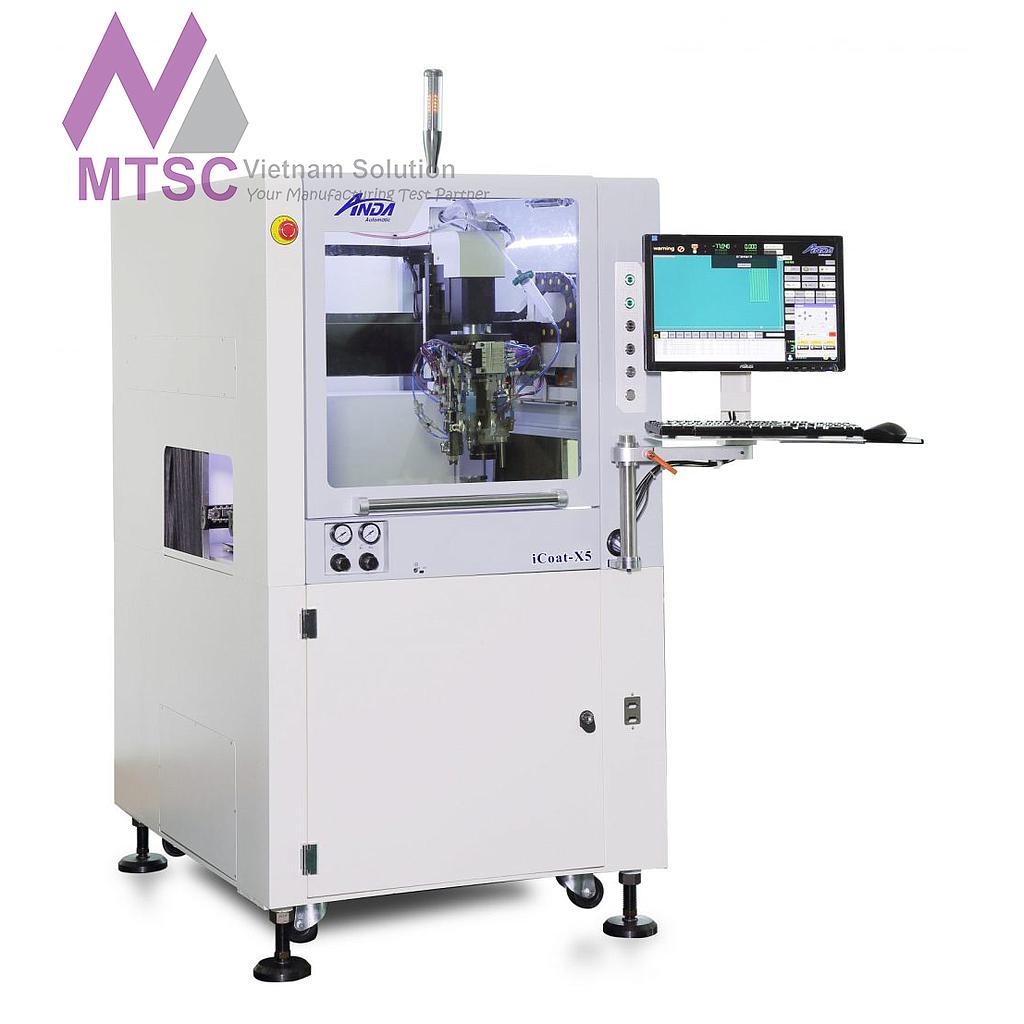
A notable example is the Anda platform, including the Anda iCoat 2 Conformal Selective Coating Machine. This system is positioned as an automated alternative to manual coating, intended to improve repeatability while helping production teams reduce labor-intensive steps. It supports selective coating of printed circuit assemblies and is designed for use in factory environments where stable output and consistent process control are important.
Based on the available product context, the iCoat 2 combines automated motion, conveyor-based handling, and multiple nozzle support in one machine. Optional functions such as CCD vision, dual-lane conveyor arrangements, and code scanning indicate that the platform can be adapted to different process requirements rather than serving only as a basic standalone applicator.
Choosing the right system for your process
The best way to evaluate a coating machine is to start with the application itself. Board size range, component height, coating pattern complexity, takt time, and keep-out area sensitivity all influence the level of automation required. A simple board with low volume may need a different setup than a product family with many variants and frequent recipe changes.
It is also important to review utilities and factory readiness. Air supply, exhaust, electrical requirements, and operator access all affect installation planning. In higher-throughput environments, teams often look beyond the coater itself and consider how the system will connect with upstream feeding, buffering, and transfer equipment such as an automatic workpiece feeding system.
Common applications and production benefits
Selective conformal coating machines are typically used where product reliability must be maintained without adding unnecessary manual masking or inconsistent spray coverage. They are well suited to electronics manufacturing environments that require controlled coating on populated PCBs, especially when assemblies include dense layouts or sensitive zones that must remain clean.
From an operational perspective, the main benefits often include lower variation between operators, cleaner application paths, reduced material waste compared with less controlled methods, and improved support for standardized work instructions. In production settings where inspection and electrical verification are also part of the workflow, these machines can complement adjacent processes such as flying probe testing and final visual checks.
What to look for when comparing systems
A useful comparison should go beyond headline specifications. Buyers typically assess how easily the machine can be programmed, how stable the coating process remains across different board designs, and how maintenance tasks such as cleaning, purging, and material changeover fit into normal production routines.
It is also worth considering future expansion. A machine that supports optional vision functions, different nozzle types, or broader line integration may provide more flexibility as production needs change. For manufacturers planning a scalable electronics assembly process, automation compatibility, serviceability, and recipe repeatability are often just as important as the initial application result.
Supporting a more consistent coating workflow
As electronics assemblies become more compact and application requirements more demanding, manual coating methods can become harder to control at scale. Selective conformal coating equipment offers a structured way to improve coating precision, integrate with line handling, and support repeatable product protection across batches.
If your process requires accurate coating placement, reduced masking effort, and better alignment with automated assembly flow, this category provides a practical starting point for evaluating suitable systems. The right choice will depend on your board design, production volume, and how the coating step fits into the wider manufacturing line.
-
-
-
-
-
-
-
-
-
-
-
-
-
-
-
-
-
-
-
-
-
-
-
-