

Carton sealer
In many packing operations, the final seal is where carton quality, transport safety, and line efficiency come together. A well-matched carton sealer helps standardize closing quality, reduce manual taping work, and keep packaging flow consistent across warehouses, production plants, and distribution environments.
This category brings together machines designed for sealing carton boxes with tape in different working styles, from semi-automatic units for regular box sizes to more flexible systems for mixed carton formats. It is especially relevant for businesses looking to improve throughput, reduce operator fatigue, and build a more reliable end-of-line packaging process.
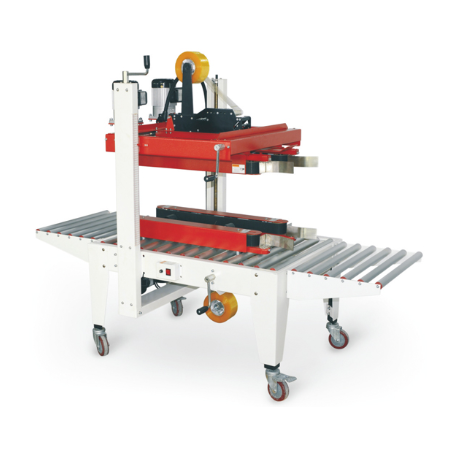
Where carton sealing machines fit in a packing line
Carton sealing equipment is typically installed near the end of a packaging workflow, after products are packed into boxes and before palletizing or shipment. In practice, these machines help apply tape consistently to the top, bottom, or both sides of the carton, depending on the sealing method and line layout.
For companies building a more integrated packaging setup, carton sealers often work alongside upstream equipment such as an auto case erector and downstream handling systems. This makes them an important part of a broader packing line where box forming, filling, sealing, and labeling need to stay synchronized.
Common machine types in this category
Not every application requires the same sealing approach. Some operations run uniform cartons all day, while others process changing box dimensions and need quicker adjustment. That is why the category includes equipment ranging from semi-automatic case sealers to automatic and random-format carton sealing machines.
Examples include the SIGNODE 4AM and SIGNODE 4AM-ND, which are suitable for routine sealing tasks where operators feed cartons through the machine. For more variable carton sizes, the SIGNODE CSM-6RM Random Carton Sealing Machine is relevant in environments where manual machine adjustment between box formats needs to be reduced.
There are also machines that support specific workflow steps beyond standard top sealing. Models such as the Mikyo MK-AS523, Mikyo MK-FX50, and Mikyo MK-FXJ4050 combine carton erecting and bottom sealing functions, which can be useful where empty cases need to be formed and prepared quickly before filling. In higher automation contexts, the LWT LW-PTA20 Carton Auto-Sealing Machine represents a more automated sealing process for completed cartons.
How to choose the right carton sealer
The most practical starting point is to review carton size range, product mix, and daily throughput. If your line handles cartons of similar dimensions, a standard semi-automatic machine may be sufficient. If box width and height vary frequently, a machine designed for random or flexible sizing can help reduce downtime caused by repeated setup changes.
It is also important to check utility requirements and operating conditions. Depending on the model, you may need to consider available power supply, conveyor speed, tape width compatibility, and whether compressed air is required. These details affect not only installation but also long-term operating stability and consumable planning.
Carton weight and box construction matter as well. Heavy, tall, or larger cartons can place extra demands on guiding, drive stability, and tape application accuracy. In these cases, equipment such as the SIGNODE 6AM Heavy Duty Case Sealer for tall and heavy cartons may be more appropriate than a lighter-duty sealer intended for standard shipping boxes.
Representative manufacturers and product options
This category includes solutions from established packaging equipment brands such as SIGNODE, LWT, and Mikyo. Each brand contributes equipment suited to different production scales, sealing formats, and carton handling requirements.
SIGNODE offers several case sealing formats, including the 4AM, 4AM-ND, FTM Flexible Taping Machine, CSM-6RM, and the 6AM heavy-duty version. These models illustrate a range from standard semi-automatic sealing to more adaptable solutions for varying carton sizes. Mikyo provides a broad mix of carton sealing and carton erecting plus bottom sealing equipment, while LWT adds an option for automatic carton auto-sealing where higher process automation is required.
Rather than focusing only on brand name, buyers should compare machine fit by carton dimension range, line speed, tape format, and the level of operator intervention needed. That approach usually leads to a better long-term result than choosing by headline specifications alone.
Applications across industrial and logistics environments
Packaging automation is relevant in many sectors, including general manufacturing, e-commerce fulfillment, consumer goods, warehousing, and export packaging. In these settings, carton sealers help create repeatable closing quality and support a smoother handoff from packing tables to conveyors, scanning, and dispatch.
Operations that process many cartons per shift often benefit from replacing manual taping with machine-assisted sealing. This can improve consistency and reduce variation between operators, especially when tape placement, box presentation, and sealing speed need to be controlled more closely.
Where a complete end-of-line solution is being developed, carton sealing is often considered together with related equipment such as a case packer or a labeling machine. Looking at the process as a system helps ensure that carton flow remains balanced from packing through shipment identification.
Key evaluation points before purchase
Before selecting a machine, it is useful to confirm several practical points with the application team: actual carton dimensions in daily production, expected throughput, tape size in use, carton weight range, and whether the boxes are uniform or mixed. These factors directly affect machine suitability and ease of operation.
Space and layout should also be reviewed carefully. Conveyor height, infeed and outfeed space, operator access, and maintenance clearance all influence how easily the sealer can be integrated into an existing line. A compact machine may suit a manual packing station, while a larger automatic model may fit better in a dedicated packaging cell.
Finally, think beyond the machine itself. Consumables, adjustment frequency, maintenance access, and future production expansion are all part of a sound B2B buying decision. A well-chosen carton sealer should support present demand while leaving room for process improvement over time.
Finding the right fit for your sealing process
A carton sealer is more than a tape applicator at the end of the line. It influences packing speed, carton presentation, operator workload, and the overall consistency of outbound packaging. The right choice depends on how your cartons move through production, how often sizes change, and how much automation the process needs.
By comparing machine style, box range, operating mode, and integration requirements, buyers can narrow the category to equipment that fits real production conditions. Whether the need is for a straightforward semi-automatic unit, a flexible random carton sealer, or a machine that supports erecting and bottom sealing as part of a larger packaging workflow, this category provides a practical starting point for selecting the right solution.
-
-
-
-
-
-
-
-
-
-
-
-
-
-
-
-
-
-
-
-
-
-
-
-