

Exploration robots
When mobile systems need to move beyond controlled factory floors and into outdoor, rough, or partially unknown environments, the focus shifts from simple automation to reliable field mobility. That is where exploration robots become especially relevant. These platforms are used to carry sensors, cameras, compute hardware, and communication equipment into areas that may be difficult, repetitive, or unsafe for direct human access.
For B2B users, this category is often less about a single robot and more about choosing the right mobile base for inspection, mapping, research, remote monitoring, or autonomous development. The most suitable platform depends on terrain, payload, runtime, navigation method, and how much integration freedom is required for sensors and software.
Where exploration robots are typically used
Many projects require a robot to operate where conditions are variable: outdoor test grounds, utility corridors, research sites, agricultural paths, campuses, industrial yards, or semi-structured environments with slopes, gravel, mud, and obstacles. In these cases, a compact indoor robot may not provide the ground clearance, weather resistance, or traction needed for dependable operation.
Exploration robots are commonly selected for remote inspection, sensor testing, environmental data collection, autonomous navigation research, and field robotics development. Some organizations also use them as development platforms for computer vision, LiDAR mapping, teleoperation, and ROS-based autonomy stacks.
What to evaluate when selecting a platform
A practical buying decision usually starts with the operating environment. Ground clearance, climb capability, drive configuration, top speed, and ingress protection all affect whether the robot can perform consistently outside the lab. Battery chemistry and runtime also matter, especially for deployments that involve long routes, remote sites, or repeated missions throughout the day.
Payload capacity is equally important. Exploration robots are often used as sensor carrier platforms, so the base must support cameras, LiDAR, thermal imaging, GPS, microphones, onboard computers, or custom enclosures without compromising stability. If the project includes software development, API support and ROS compatibility can be just as important as mechanical specifications.
Clearpath platforms in this category
Clearpath is a well-known manufacturer for unmanned ground vehicle development platforms, and several of its systems illustrate how this category spans from compact research robots to heavier outdoor vehicles. Rather than serving one narrow use case, these platforms support a range of exploration and field robotics workflows.
The Clearpath Jackal Unmanned Ground Vehicle is a smaller platform suited to lighter payloads and agile movement, making it useful for robotics development, sensor integration, and testing in constrained spaces. For more demanding terrain and payload requirements, the Clearpath HUSKY A200 and Clearpath HUSKY A300 provide a more rugged mid-size base with higher carrying capacity and outdoor-oriented mobility. At the larger end, the Clearpath WARTHOG Unmanned Ground Vehicle supports substantially heavier payloads and faster movement for projects that need more power and space for equipment.
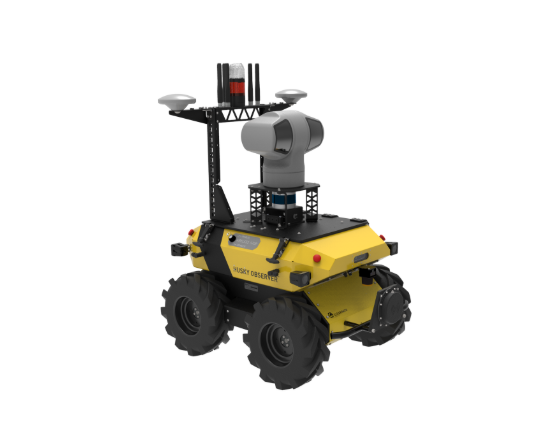
For inspection-oriented scenarios, the Clearpath Husky Observer Unmanned ground vehicle highlights a different angle within exploration robotics: combining mobility with integrated sensing such as zoom imaging, audio capture, and optional thermal capability. That makes it relevant for remote observation tasks where the mobile base is only one part of the overall field data solution.
From mobility base to complete field system
In real deployments, the robot chassis is only the starting point. A field-ready solution may include navigation sensors, communications, power distribution for user devices, onboard compute, and software interfaces for autonomy or teleoperation. This is why many buyers evaluate exploration robots as part of a broader system architecture rather than as standalone machines.
For example, a platform may need to combine stereo or RGB cameras with 2D or 3D LiDAR, RTK GPS, or thermal imaging depending on the mission. A compact robot can be a strong fit for route testing and algorithm validation, while a heavier platform may be better suited for carrying larger batteries, industrial sensors, or inspection payloads over longer distances and rougher ground.
Matching robot size to the mission profile
Smaller exploration robots are often preferred when maneuverability, transport convenience, and shorter setup time matter most. They can be easier to deploy in research programs, pilot projects, and application prototyping. If the mission mainly involves developing navigation software or validating perception pipelines, a lighter platform may provide enough capability without unnecessary complexity.
Larger vehicles become more attractive when there is a need for greater endurance, higher payload, wider operating range, or better performance on uneven outdoor terrain. A robust skid-steer platform with stronger power options and more user power outputs can support a broader mix of sensors and auxiliary equipment. Choosing the right size early helps avoid integration issues later in the project lifecycle.
How this category relates to other mobile robot types
Exploration robots overlap with several nearby categories, but the intended operating context is different. If the project centers on moving goods between points in a facility or campus setting, delivery robots may be more relevant. If the objective is autonomous floor maintenance or surface care, cleaning robots represent a more specialized path.
Some projects also sit close to human-facing service applications, where assistant robots may be a better fit than field exploration platforms. By contrast, exploration robots are usually chosen for mobility in less predictable environments, technical payload integration, and development flexibility rather than customer interaction or routine indoor service tasks.
Practical considerations for technical buyers
Beyond headline specifications, procurement teams should review how the robot will be supported in day-to-day engineering work. Important questions include available interfaces, charging method, networking options, environmental tolerance, and whether the robot can be adapted as project requirements evolve. A platform that works well in early testing but lacks room for future payloads may create avoidable redesign costs.
It is also useful to consider whether the platform will be used primarily for teleoperation, autonomous navigation, or hybrid operation. That choice influences sensor selection, communication architecture, and compute requirements. In some cases, organizations comparing field platforms may also want to browse adjacent concepts such as animal robots when mobility behavior or terrain interaction is part of the broader robotics evaluation process.
Choosing the right exploration robot
The best fit usually comes from aligning the platform with the mission, not from selecting the largest or most advanced option by default. Terrain, payload, runtime, software stack, and sensing requirements should all be considered together. A compact platform such as Jackal may be appropriate for agile development and lighter instrumentation, while Husky or WARTHOG platforms may better support demanding outdoor work and heavier sensor packages.
As this category shows, exploration robots can support everything from research and mapping to inspection and autonomous system development. Reviewing the platform’s mobility characteristics, integration options, and intended operating conditions will make it easier to narrow the shortlist and build a system that performs reliably in the field.
-
-
-
-
-
-
-
-
-
-
-
-
-
-
-
-
-
-
-
-
-
-
-
-