

Line laser
Accurate alignment makes a visible difference in construction, interior fit-out, MEP installation, and site layout work. When straight reference lines, plumb points, or level planes need to be transferred quickly, line laser tools help reduce manual marking time while improving consistency across repeated tasks.
On this page, you can explore line and point laser solutions used for leveling, squaring, and positioning in practical field conditions. The range includes compact units for indoor installation work as well as more robust rotary models for wider coverage, helping buyers compare the right format for daily jobsite requirements.
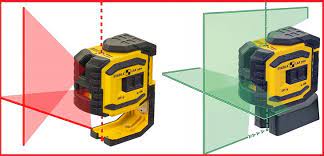
Where line laser tools are commonly used
Laser leveling equipment is widely used in partition installation, suspended ceilings, flooring, tiling, door and window alignment, cable tray routing, and general construction layout. Compared with traditional bubble levels or chalk lines, a laser reference is faster to project and easier to follow over longer distances or across multiple points.
For contractors, maintenance teams, and technical installers, the main value lies in repeatability. A stable horizontal, vertical, or plumb reference helps reduce rework when fitting components that must stay aligned over a room, corridor, or open work area.
Typical laser formats in this category
Not every job calls for the same beam pattern. Some tools are designed to project simple reference points, while others generate full lines or rotating beams for large-area leveling. Understanding this difference is usually the quickest way to narrow down a suitable model.
Point lasers are useful for transferring plumb points or checking alignment between floor and ceiling. Examples in this range include the FLUKE PLS 3R Z 3-Point Red Laser Bare Tool, FLUKE PLS 3G Z 3-Point Green Laser Kit, and FLUKE PLS 5G Z Laser Level for applications that need visible points and straightforward setup.
Rotary laser levels are better suited to longer working distances or outdoor-related layout tasks, especially when used with a detector. Models such as the FLUKE PLS H2 KIT Rotary Laser Level, FLUKE PLS H2 SYS Rotary Laser Level, and FLUKE PLS HV2G SYS Manual Slope Green Rotary Laser System illustrate this heavier-duty end of the category.
Red beam or green beam: which is more practical?
Beam color affects visibility more than measurement principle. In many indoor environments, red lasers remain a practical and cost-conscious option for standard alignment tasks. Models such as the FLUKE PLS 5R Z 5-Point Red Laser Kit or FLUKE PLS 5R KIT 5-Point Red Laser Kit are often relevant when users need dependable point references in normal lighting conditions.
Green beam lasers are generally easier to see in brighter areas, which can improve working comfort when ambient light is strong. Products like the FLUKE PLS 3G KIT 3-Point Green Laser Kit and Milwaukee (tool) M12 3PL 3-Plane Laser are examples often considered by teams that want clearer beam visibility during installation and layout work.
In practice, color should be selected together with jobsite conditions, working distance, and required beam pattern. Visibility alone does not replace proper accuracy, stability, and mounting suitability.
What to check before choosing a line laser
A good selection process starts with the task, not just the model name. For short-range indoor work, buyers often focus on accuracy, self-leveling behavior, runtime, and how many reference directions are available. For wider-area layout, operating range and detector compatibility become more important.
- Accuracy: Choose a tool that matches the tolerance of your installation or layout work.
- Beam pattern: Decide whether you need points, planes, horizontal-only, or horizontal and vertical references.
- Working range: Larger sites may require a rotary system and detector support.
- Protection level: Dust, moisture, and impact resistance matter on active jobsites.
- Power setup: Battery type and runtime affect downtime and field convenience.
For example, some FLUKE rotary models in this category are designed for extended range operation and durable field use, while compact point laser units are more convenient for interior alignment and transfer tasks. If your workflow includes multiple trades, a flexible system may be more useful than a highly specialized one.
Examples of products in this range
This category includes representative solutions from FLUKE and Milwaukee (tool), covering both compact installation tools and larger rotary systems. The Milwaukee (tool) M12 3PL 3-Plane Laser is a good example of a multi-plane format intended for practical layout work where fast line projection is needed across several directions.
For users who need horizontal-only or horizontal-and-vertical rotary functionality, the FLUKE PLS H2 Z Rotary Laser Level, FLUKE PLS HV2R KIT Manual Slope Red Rotary Laser Kit, and FLUKE PLS HV2G SYS Manual Slope Green Rotary Laser System provide a useful picture of the broader application range available on the page.
If you are also comparing by brand ecosystem, you may want to browse the wider selection from Milwaukee (tool) or review other measuring and installation tools from BOSCH depending on your preferred platform and workflow.
How line lasers fit into a broader measurement workflow
Laser leveling tools are often only one part of a larger site measurement process. On many projects, they are used alongside positioning, communication, and motion-related equipment to support setup, verification, and coordination between teams.
For applications involving movement monitoring or speed-related measurement, related categories such as speed sensors may be relevant. While these products serve a different purpose, they sit within the same wider measurement ecosystem where accurate reference and reliable field data are both important.
Practical usage tips for better results
Even a capable laser tool needs correct setup to deliver consistent results. Place the unit on a stable base, verify the self-leveling range, and avoid relying on a projected line when the instrument is outside its intended leveling condition. On active sites, vibration and accidental movement can introduce avoidable errors.
It is also useful to match the tool to the environment. Compact point and line lasers are efficient for room-scale installation work, while rotary units are more suitable when references need to be carried over greater distances. In brighter settings, a green beam may improve visibility, but accessories and setup discipline still matter for dependable alignment.
Choosing the right option for your application
The right line laser depends on whether your priority is indoor installation speed, plumb and point transfer, long-distance leveling, or stronger beam visibility. A compact point laser can be enough for straightforward alignment work, while a rotary model is often the better fit for larger spaces and extended layout tasks.
By comparing beam type, coverage, durability, and operating conditions, buyers can narrow the selection to tools that match real jobsite demands instead of choosing by specification alone. Explore the available products in this category to find a laser leveling solution that fits your workflow, working environment, and accuracy requirements.
-
-
-
-
-
-
-
-
-
-
-
-
-
-
-
-
-
-
-
-
-
-
-
-