

Light meter
Accurate illumination measurement is essential in workplaces where lighting quality affects safety, visual comfort, inspection reliability, and energy performance. From production areas and laboratories to building maintenance and lighting audits, a light meter helps teams verify whether actual light levels match operational requirements instead of relying on visual judgment alone.
This category brings together handheld lux and foot-candle measuring instruments used for routine checks, commissioning, troubleshooting, and documentation. Whether the priority is a compact meter for quick spot measurements or a more advanced unit with memory, USB, or app-based data handling, the selection here supports a wide range of technical B2B applications.
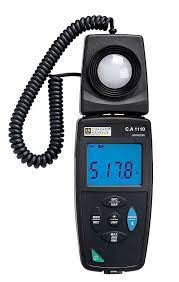
Where light meters are used in practice
Illumination measurement is relevant anywhere lighting conditions influence process quality or working conditions. Common examples include factory floors, warehouses, offices, schools, hospitals, retail spaces, clean work areas, and maintenance inspections for indoor lighting systems.
In many projects, the goal is not simply to read a number in lux. Users may need to compare zones, verify uniformity, document compliance, or evaluate whether an existing lamp setup is delivering enough light at the working surface. In broader optical and environmental measurement workflows, related tools such as UV meters or color sensors may also be relevant depending on what needs to be characterized.
What to look for when choosing a light meter
The first step is to check the measuring range. Some applications only need lower indoor lux levels, while others require wide-range measurement for brighter installations, test benches, or lighting system validation. Models in this category cover a broad span, from standard indoor readings to instruments capable of measuring up to 100,000 lux, 199,900 lux, 200,000 lux, or even 400,000 lux depending on the device.
Another key factor is sensor performance. Many practical meters use a silicon photodiode with optical filtering, and good instruments are designed with cosine correction and color correction in mind so the reading better reflects real incident light. Resolution, response time, display readability, and support for both lux and foot-candle units are also important, especially for teams working across different standards or customer requirements.
Portable models for routine field measurement
For everyday maintenance and spot checks, compact handheld instruments are often the most efficient choice. The FLUKE FLUKE-941 ESP Light Meter is a representative example for straightforward illumination measurement, with multiple lux and foot-candle ranges, a separate sensor, and a portable form factor suited to indoor use. This type of meter is practical for electricians, facility teams, and service engineers who need quick readings across several points.
Another accessible option is the Amprobe LM-100 Light Meter, which measures in both lux and footcandles and uses a silicon photodiode and filter. For users who want a little more on-device review capability, the Amprobe LM-120 adds min/max support, which can be useful when checking fluctuating lighting conditions over a short period.
Wide-range and advanced logging options
When measurements need to be stored, transferred, or reviewed later, more advanced instruments become valuable. The EXTECH HD450 Datalogging Heavy Duty Light Meter supports high-range measurements and datalogging, making it suitable for survey work, maintenance records, or repeated comparative measurements across multiple rooms or production zones.
The HIOKI FT3424 Lux Meter is another strong fit where users need functions beyond a basic live reading. Its memory capability, manual or auto range operation, and USB bus power support make it attractive for users who want to capture a series of measurements and handle them more systematically. For teams already standardizing around a particular brand ecosystem, browsing the wider HIOKI range can help align accessories and service preferences.
Examples for specialized workflows
Not every requirement calls for a dedicated single-function handheld meter. Some users need combined environmental checks during HVAC, facility diagnostics, or building services work. The EXTECH 45170 Pocket Hygro-Thermo-Anemometer-Light Meter is a good example of a multifunction instrument that includes light measurement alongside air velocity, temperature, and humidity, helping technicians reduce the number of devices they carry.
For modern inspection workflows, connectivity can also matter. The TESTO 545 Digital Lux Meter With App Connection and the TESTO 440 Lux Kit show how light measurement can be integrated into a broader digital documentation process. In projects where readings may need to be reviewed on mobile devices or transferred through USB or Bluetooth, these features can improve traceability and reporting efficiency. Users interested in this ecosystem can also explore the TESTO brand page for related instruments.
How measurement features affect real-world results
A specification sheet matters most when it changes field usability. A backlit display can make readings easier to confirm in dim areas, while auto power-off helps preserve battery life during mobile work. Data hold, min/max review, and memory storage are particularly useful when the operator must move between the sensor position and the display, or when readings must be recorded without a second person.
Datalogging, USB connectivity, and app integration become more important in audits, maintenance documentation, and quality control. If the task involves only occasional checks, a simpler model may be enough. If the task involves recurring surveys, trend comparison, or customer reporting, then it is worth selecting a meter designed for data capture rather than only instant display.
Popular brands and representative products in this category
This category includes products from established manufacturers commonly used in industrial and technical environments, including FLUKE, EXTECH, HIOKI, TESTO, and Amprobe. A few representative examples are the FLUKE FLUKE-941 ESP Light Meter, EXTECH LT300 Digital & Analog Display Light Meter, EXTECH EA30 Wide Range Light Meter, HIOKI FT3424 Lux Meter, TESTO 545 Digital Lux Meter With App Connection, and Amprobe LM-120 Light Meter.
Each model is positioned a little differently. Some prioritize portability and ease of use, some offer a wide measurement range, and others focus on memory, logging, or connected workflows. Choosing the right instrument depends less on brand name alone and more on where the meter will be used, how often measurements are taken, and whether the readings need to be documented or exported.
Choosing the right light meter for your application
If you are comparing options, start with the actual measurement environment: indoor maintenance, office lighting checks, industrial inspection, laboratory work, or service documentation. Then narrow the selection based on range, unit support, sensor design, portability, and whether features such as min/max, memory, USB, Bluetooth, or app support will save time in day-to-day use.
A well-matched lux meter helps turn lighting from a subjective impression into a measurable parameter that can be checked, recorded, and improved. Explore the products in this category to find a model that fits your required range, workflow, and level of reporting detail.
-
-
-
-
-
-
-
-
-
-
-
-
-
-
-
-
-
-
-
-
-
-
-
-