

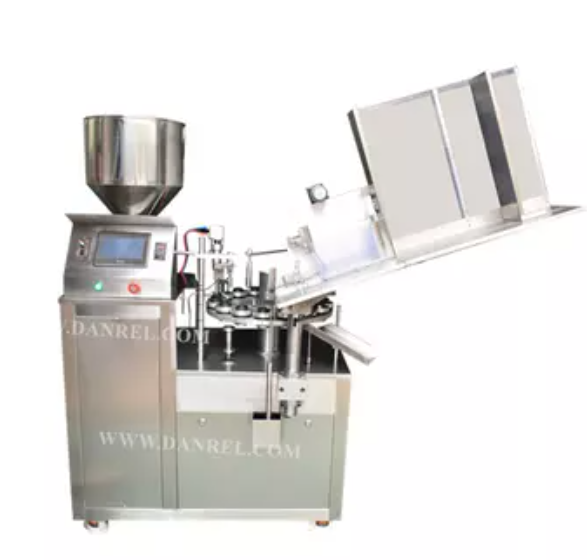
Aluminum Tube Filling and Sealing Machine
When creams, ointments, gels, adhesives, and chemical pastes need to be packed in metal tubes, consistency in dosing and seal quality becomes a critical part of the production process. Choosing the right Aluminum Tube Filling and Sealing Machine helps manufacturers maintain stable output, reduce product waste, and achieve a cleaner, more repeatable packaging workflow.
This category focuses on equipment designed for filling and sealing aluminum or metal tubes across a range of product viscosities and batch sizes. It is especially relevant for pharmaceutical, cosmetic, personal care, and specialty chemical applications where tube integrity, accurate filling, and neat end sealing directly affect product presentation and downstream handling.
Why aluminum tube packaging is still widely used
Aluminum tubes remain a practical packaging format for products that benefit from strong barrier properties and controlled dispensing. They are commonly selected when protection from light, air, or contamination is important, and they are also useful for formulations that require a durable, shape-retaining container.
In production, metal tubes demand a different sealing approach than plastic tubes. The machine must not only dose the product accurately, but also handle tube positioning, end folding or sealing, and process stability under pneumatic and mechanical operation. That is why this category serves a distinct need compared with plastic tube filling and sealing equipment.
What to expect from this machine category
Machines in this range are built to support the core steps of tube filling, orientation, sealing, and discharge for aluminum tube packaging lines. Depending on the production setup, users may choose between semi-automatic models for flexible small-to-medium batch work and fully automatic systems for higher throughput and more standardized operation.
Typical selection factors include filling volume range, tube diameter compatibility, tube length range, machine speed, pressure requirements, and the desired level of automation. In many facilities, the right choice depends less on headline speed alone and more on how well the machine fits the product type, changeover frequency, and labor arrangement on the shop floor.
Typical applications and production environments
Aluminum tube filling systems are often used for products that must be dispensed in a controlled way and packed with a secure closure. Common use cases include medicated creams, topical ointments, cosmetic pastes, industrial compounds, and similar semi-liquid products that need a dependable tube-packaging process.
For regulated or quality-sensitive environments, filling precision and repeatability are especially important. Machines in this category are intended to support stable operation through controlled filling volumes and consistent sealing performance, helping reduce underfill, overflow, and variation between batches.
Choosing between semi-automatic and fully automatic systems
A semi-automatic machine is usually a suitable option for companies handling smaller batches, more frequent product changes, pilot production, or operations where an operator remains closely involved in loading and handling tubes. For example, the Danrel DR-SALG40 Semi-Automatic Aluminum Tube Filling And Sealing Machine fits the profile of a machine intended for more flexible production conditions.
By contrast, fully automatic equipment is generally better aligned with higher-volume manufacturing, where repeatability, reduced manual intervention, and steady line rhythm are priorities. Models such as the Danrel DR-FALG60 Automatic Aluminum Tube Filling And Sealing Machine and Danrel DR-FALG80 Fully Automatic Metal Tube Filling And Sealing Machine with Charging Machine illustrate this more automated approach, with machine layouts intended to support continuous processing of metal tubes.
If your production includes both metal and polymer packaging formats, it may also be useful to compare requirements across aluminum tube filling and sealing machines and plastic tube alternatives, since sealing methods, tube behavior, and machine configuration can differ significantly.
Representative equipment in this category
This selection includes machines from Danrel, with options covering semi-automatic and automatic operation for metal tube packaging. The DR-FALG60 and DR-FALG80 are relevant for businesses looking for automated aluminum tube filling and sealing solutions, while the DR-SALG40 offers a more operator-assisted format for applications that value flexibility.
Although this category is centered on aluminum tubes, it is also useful to understand adjacent equipment such as the Danrel GF-400L Automatic plastic tube filling and sealing machine. That broader view can help buyers distinguish between machine types based on tube material, sealing method, and product packaging goals, especially when planning future line expansion or mixed-format production.
Key points to evaluate before ordering
Before selecting a machine, it is important to review the practical details of the packaging job rather than focusing only on nominal capacity. Tube dimensions, target fill volume, product texture, available air supply, power requirements, and expected daily output all influence whether a machine will integrate smoothly into your process.
It is also worth considering the operator workflow around the machine. Loading method, cleaning access, adjustment convenience, and changeover requirements can have a direct effect on uptime. For B2B buyers, the best fit is usually the machine that balances filling accuracy, realistic throughput, and compatibility with the actual tube and product specifications used in production.
- Tube material and whether the machine is intended for aluminum or broader metal tube formats
- Supported tube diameter and length range
- Required filling volume and expected accuracy
- Desired automation level and labor involvement
- Available plant utilities such as air pressure and power supply
How this category supports packaging line planning
For many manufacturers, a tube filling machine is not purchased as a standalone unit in theory, but as part of a wider packaging workflow. The machine should fit the expected product range, operating rhythm, and downstream packaging steps without creating a bottleneck or requiring excessive manual correction.
This is why category-level evaluation matters. By comparing aluminum-focused models in one place, buyers can better identify whether they need a compact semi-automatic unit, a more automated production machine, or a broader review of related tube packaging equipment before finalizing a purchase decision.
Final considerations
Selecting the right aluminum tube filling and sealing solution starts with understanding the product, the tube format, and the level of automation your production actually requires. A well-matched machine can improve dosing consistency, support cleaner sealing results, and make day-to-day operation easier for the packaging team.
Whether you are upgrading an existing line or specifying equipment for a new project, this category provides a focused starting point for comparing metal tube packaging options. Reviewing machine type, working range, and process fit in detail will make it easier to choose equipment that supports stable production over time.
-
-
-
-
-
-
-
-
-
-
-
-
-
-
-
-
-
-
-
-
-
-
-
-