

Strain and Force Datalogger
When load, deformation, and mechanical stress need to be tracked over time, choosing the right logger is just as important as selecting the sensor itself. A reliable Strain and Force Datalogger helps capture meaningful measurement data from strain gages, strain-gage transducers, and related sensing points in testing, product development, structural monitoring, and industrial evaluation.
On this page, you can explore dataloggers designed for applications where signal stability, channel handling, sampling behavior, and practical data export matter. The category includes compact multi-channel instruments as well as broader logging platforms suitable for longer-term monitoring or more complex measurement setups.
Where strain and force dataloggers are used
These instruments are commonly used wherever mechanical behavior needs to be recorded rather than observed only in real time. Typical use cases include material testing, machine load verification, fixture evaluation, prototype validation, and monitoring of structures or components under changing operating conditions.
In many projects, the goal is not only to read a signal but to log it with enough quality for later analysis. That makes factors such as synchronous measurement, sampling rate, channel count, and stability especially important. For teams working across multiple types of physical variables, it can also be useful to compare this category with electric dataloggers when the primary signal is voltage or current rather than strain-based sensing.
Typical device types in this category
Within this category, some models are focused on direct strain measurement with bridge-based sensor support, while others are built for wider logging tasks that can include pressure and related process values. The most suitable choice depends on whether your application is centered on strain gages, force transducers, or a broader data acquisition requirement.
For example, the KYOWA PCD-400A and PCD-400B are compact 4-channel strain data loggers intended for strain gages and strain-gage transducers. They support multi-channel measurement in a compact format and are relevant for bench testing, portable setups, and applications where a smaller footprint is preferred.
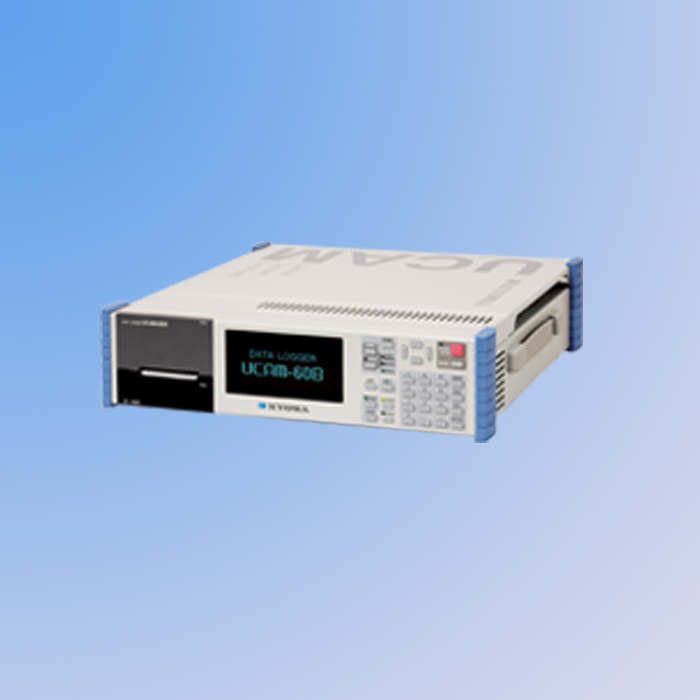
For larger channel requirements, the KYOWA UCAM-60B-AC and UCAM-60B-DC provide a more scalable approach. These models are designed for broader measurement tasks and support functions such as data storage, trigger-based measurement, interval measurement, and CSV conversion, which are useful in long-running test programs or structured measurement sequences.
Key selection factors before you buy
The first point to confirm is sensor compatibility. In strain measurement, that usually means checking whether the logger supports the bridge configuration and resistance range used by your strain gages or transducers. If your setup includes quarter bridge, half bridge, or full bridge arrangements, the logger should match that measurement architecture without requiring unnecessary workarounds.
The next consideration is channel count and expansion. A compact 4-channel logger may be ideal for localized testing, but larger systems may need scalable channel capacity for distributed measurements across multiple points. In applications that also require remote deployment or network-based access, it may be worth reviewing Ethernet and wireless data loggers for comparison.
Sampling behavior also matters. Faster sampling is useful for transient events and dynamic mechanical changes, while slower interval logging may be more appropriate for long-duration monitoring. Resolution, filtering, balance adjustment, and data export workflow all influence how usable the final dataset will be in engineering analysis.
Examples from leading manufacturers
OMEGA appears in this category with pressure data logger models such as the OM-CP-PR140 series and OM-CP-PR2000 variants. While these are pressure-focused rather than dedicated strain loggers, they show how some monitoring tasks overlap with force- or load-related measurement environments, especially where pressure is used as an indirect process variable in validation or equipment monitoring.
The OM-CP-PR140 models are designed for compact pressure logging and high-temperature environments, while the OM-CP-PR2000 series adds an LCD display and larger onboard memory capacity. These products may be relevant when a project includes both strain-based evaluation and pressure logging in the same test ecosystem.
For more specialized mechanical measurement, KYOWA remains the clearer fit in this category because the listed models are explicitly built around strain gages, bridge measurement, and multi-channel data handling. This makes them especially relevant for users who need dedicated tools for deformation, load, or structural response recording.
What to look for in day-to-day operation
Beyond core specifications, usability in the field or lab can strongly affect productivity. Features such as USB connectivity, onboard storage, automatic balance methods, trigger functions, and straightforward file conversion can reduce setup time and simplify data handling after a test is complete.
In repetitive test procedures, it is often helpful to have configurable measurement modes, interval logging, or trigger-based recording so the logger captures only the events that matter. This is particularly valuable in endurance testing, step-by-step validation, and applications where mechanical changes occur only under certain thresholds or sequences.
If your broader monitoring environment includes non-mechanical parameters, complementary categories such as humidity and temperature dataloggers can help support a more complete view of test conditions without forcing one logger type to handle every variable.
Choosing between compact and scalable systems
A compact logger is often the right answer when the measurement task is focused, the channel count is low, and portability matters. Devices like the PCD-400A or PCD-400B fit well in development labs, maintenance diagnostics, and temporary measurement setups where engineers need dependable strain logging without a large rack-based system.
A more scalable platform becomes attractive when the project expands to many channels, mixed sensor inputs, or long-term automated measurement. In these cases, functions such as self-diagnostics, scheduled measurement, trigger logic, and external scanner support can provide a better foundation for structured testing programs.
The right balance depends on how your measurement process is organized: a small number of critical points with faster deployment, or a larger data collection framework with broader monitoring coverage.
How this category fits into a wider data logging workflow
Strain and force logging is rarely isolated from the rest of the test environment. Mechanical measurements are often reviewed alongside electrical signals, environmental conditions, event timing, or process variables. That is why selecting a logger should be part of a wider instrumentation decision, not only a sensor matching exercise.
For some applications, the best result comes from combining dedicated strain logging with other specialized devices instead of relying on one generalized unit. If your testing also depends on discrete changes or timestamped operational events, related tools such as event data loggers may help round out the monitoring strategy.
Conclusion
This category is intended for users who need dependable logging of mechanical response, whether for strain-gage measurement, force-related evaluation, or adjacent monitoring tasks tied to test and validation work. From compact 4-channel strain loggers to larger-scale systems with automated measurement functions, the available options support different levels of complexity and deployment.
When comparing models, focus on sensor compatibility, channel architecture, data handling, and the way the logger will be used in practice. A well-matched data logger not only records values, but also makes analysis, traceability, and engineering decisions much easier over the full life of a project.
-
-
-
-
-
-
-
-
-
-
-
-
-
-
-
-
-
-
-
-
-
-
-
-