

Phase shifter
Accurate phase control is essential in many RF and microwave systems, especially when engineers need to align signals, optimize test setups, or fine-tune transmission paths across a defined frequency range. This category brings together phase shifter solutions used in telecommunication and measurement environments where repeatable signal adjustment matters as much as bandwidth and power handling.
Whether the requirement is broad frequency coverage for lab work or a more targeted range for system integration, phase shifters help manage signal timing relationships without changing the underlying frequency. In practice, they are often selected alongside other RF building blocks such as isolators, switching devices, and passive distribution components to create stable and flexible signal chains.
Where phase shifters fit in RF and telecom systems
A phase shifter is used to change the phase angle of an RF signal while keeping operation within a specified frequency band. This makes it useful in applications such as signal path matching, antenna and beamforming development, laboratory verification, and microwave subsystem tuning.
In a broader RF setup, the phase shifter is rarely a stand-alone component. It is typically part of a chain that may also include power divider products for signal splitting, adapters for connectivity, and switches for routing between different paths or instruments. Selecting the right device depends on how precisely the signal phase must be adjusted and how much insertion loss the system can tolerate.
What to consider when choosing a phase shifter
The most important selection factor is usually the frequency range. A device designed for 2200 to 3800 MHz addresses a very different use case from one operating across 8000 to 18000 MHz or a super-wideband digital design that spans 400 to 6000 MHz. Matching the operating band to the application is the first step in avoiding poor performance or unnecessary complexity.
Other key points include phase adjustment range, resolution, input power capability, insertion loss, and whether the design is uni-directional or bi-directional. For precise test environments, fine phase resolution can be especially valuable. In integrated RF paths, designers may pay closer attention to loss, return loss, and the effect of the component on overall signal integrity.
Representative solutions in this category
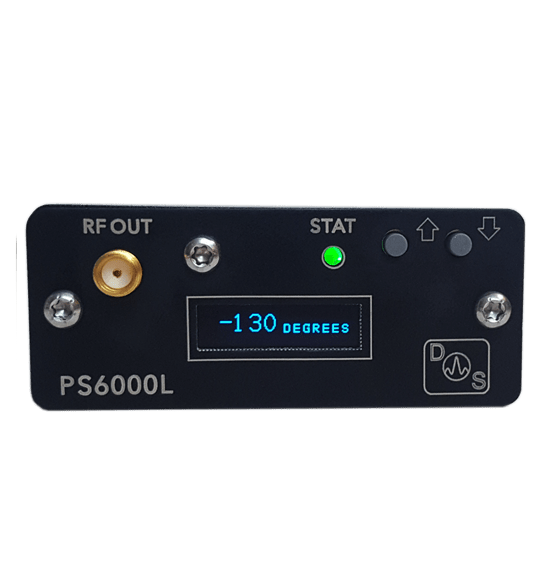
This range includes several models from DS INSTRUMENTS, covering different frequency bands and operating styles. For example, the DS INSTRUMENTS PS6000L Digital Phase Shifter supports an exceptionally wide 400 to 6000 MHz range with digital control, a phase span from -180 to +180 degrees, and very fine 1/2-degree resolution. That profile makes it especially relevant for bench testing and applications that require controlled, repeatable adjustment over a wide band.
For more band-specific requirements, models such as the DS INSTRUMENTS PS6000P and PS3800 provide phase shifting for 3500 to 6000 MHz and 2200 to 3800 MHz respectively. These units offer a 0 to 355 degree range and bi-directional operation, making them suitable where signal direction flexibility and straightforward RF integration are important.
Higher-frequency options are also represented by the DS INSTRUMENTS PS12000 and PS18000. These support microwave bands up to 12 GHz and 18 GHz, giving engineers practical choices for more demanding high-frequency environments where phase adjustment still needs to remain controlled and predictable.
Digital and analog-style selection logic
One useful way to approach selection is to consider how the phase setting will be used in the real system. A digitally controlled model with fine resolution is generally better suited to automated test setups, calibration routines, or applications where repeatability between settings is important. It can also simplify remote adjustment compared with more basic implementations.
By contrast, a narrower-band RF phase shifter with standard step resolution may be appropriate when the operating band is fixed and the goal is straightforward phase trimming within a known architecture. In those cases, engineers often balance available phase range, insertion loss, and power handling rather than prioritizing ultra-wideband coverage.
Integration considerations in measurement and telecom environments
Even a well-matched phase shifter should be evaluated as part of the complete RF path. Connector transitions, source power level, downstream sensitivity, and the presence of other passive or active components can all affect final system behavior. If the setup includes multiple signal routes, telecommunication switches may be used to manage path selection while preserving a flexible test architecture.
It is also important to look beyond phase range alone. A unit with broader angle control may still be less suitable if its insertion loss or return performance does not align with the rest of the signal chain. For this reason, phase shifters are often chosen together with supporting RF components rather than in isolation.
Typical applications for phase shifters
In practical terms, these devices are commonly used in RF test benches, communication subsystem development, microwave research, and signal conditioning tasks where phase alignment directly affects measurement accuracy or system behavior. They can help compare paths, compensate for differences between channels, or support controlled variation during characterization work.
They are also relevant in antenna-related development and multi-path signal setups, where changing the relative phase between paths influences constructive or destructive combination. In those environments, the choice of phase shifter often depends on how much control is needed over the adjustment step size and how broad the operating frequency window must be.
How to narrow down the right model
A practical buying approach starts with three questions: what frequency band must be covered, how much phase resolution is needed, and what input power levels are expected in operation. From there, it becomes easier to compare a wideband digital model such as the PS6000L against more focused band-specific units like the PS3800, PS6000P, PS12000, or PS18000.
If your application involves automated measurement, repeatable tuning, or variable signal output control, a digitally oriented option may be the better fit. If the requirement is a stable RF component for a fixed band with known path conditions, one of the dedicated frequency-range models may be more appropriate. Reviewing the full product details on each item page will help confirm compatibility with your test or telecom setup.
Final thoughts
The right phase shifter can improve signal alignment, simplify RF adjustment, and support more reliable telecom or measurement workflows. By focusing on operating band, control method, loss characteristics, and integration needs, engineers can select a device that fits the real demands of the system rather than only the headline specifications.
This category is intended to make that comparison easier, with options spanning wideband digital control and targeted microwave frequency ranges. If you are building or refining an RF signal chain, these products provide a solid starting point for evaluating phase control requirements in a practical way.
-
-
-
-
-
-
-
-
-
-
-
-
-
-
-
-
-
-
-
-
-
-
-
-