

Smart Factory
As production volumes grow and floor space becomes harder to expand, many manufacturers look for ways to increase storage density without slowing material flow. In a Smart Factory environment, storage is no longer just a static warehouse function; it becomes part of a connected system that supports picking speed, inventory visibility, operator safety, and smoother supply to the line.
This category focuses on solutions that help industrial sites organize parts, long materials, tools, and work-in-process more efficiently through automated vertical storage. These systems are especially relevant where traceability, high picking frequency, and better use of available building volume are important to daily operations.
Why automated storage matters in smart manufacturing
A modern factory needs more than storage capacity. It needs fast access to materials, reliable stock control, and layouts that support production rather than interrupt it. Automated vertical storage helps achieve this by bringing stored items to the operator, reducing unnecessary walking, search time, and manual handling.
In many facilities, these systems also support better inventory discipline. When storage and retrieval are structured, it becomes easier to track stock levels, reduce picking errors, and protect materials from dust, damage, or unauthorized access. This is one reason they are often considered alongside broader assembly and inspection solutions where material availability directly affects throughput.
Key storage scenarios covered in this category
The solutions shown here are suitable for several common industrial needs. Some applications focus on compact storage for small parts, components, spare parts, kits, and supplies. Others are designed for more demanding loads such as tools, moulds, dies, rolled goods, or semi-finished products used as buffer stock between operations.
Another important scenario is the handling of long and bulky items such as bars, profiles, tubes, and sheet material. In these cases, vertical storage can improve accessibility while using far less floor space than conventional shelving or horizontal racks. For manufacturers balancing warehouse efficiency with production continuity, this kind of flexibility is highly valuable.
Representative ICAM solutions for smart factory storage
This category includes notable systems from ICAM, a manufacturer focused on automated storage technologies. Different models address different operating priorities, from high-density general storage to fast picking and specialized handling of long or heavy materials.
ICAM Silo 2 is a multi-column vertical storage system intended for intensive storage with a modular approach. Its configuration flexibility makes it relevant for sites with space constraints, irregular layouts, or the need to scale storage capacity over time. It is suitable for applications such as parts, spare parts, tools, kits, and buffer storage.
ICAM Silo Plus is more oriented toward rapid picking of light loads and order-oriented workflows. With tray formats designed around standard containers, it fits operations where order fulfillment, consolidation, and line feeding are central. For factories seeking higher throughput in internal logistics, this type of system can play a practical role.
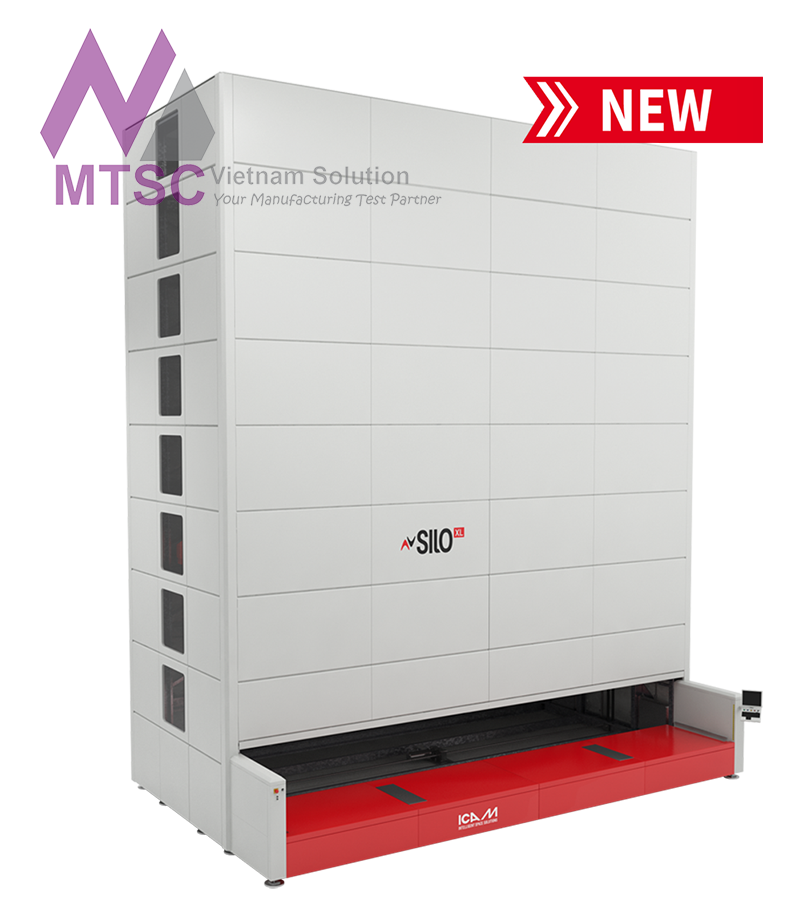
ICAM Silo L and ICAM Silo XL extend the concept toward multipurpose and long-item storage. Silo L supports a wide range of tray sizes and applications, while Silo XL is positioned for long and heavy items, with features intended to improve handling reliability and the use of vertical space in a compact footprint.
How to choose the right system for your application
The best choice usually depends on the type of material being stored, how often it is accessed, and how closely storage needs to interact with production. If your operation mainly handles small parts or containers with frequent picking, a system optimized for fast retrieval and order preparation may be the better fit. If the challenge is storing mixed materials, components, or semi-finished goods in a compact footprint, a more versatile multipurpose configuration may be more appropriate.
For long stock, heavy loads, or materials that are awkward to move manually, storage geometry and tray capacity become more important than pure picking speed. In those cases, systems built for long-item access and safer operator handling should be prioritized. It is also worth considering whether the warehouse needs to support future expansion, multiple access points, or integration into a broader smart factory workflow.
Operational benefits beyond space saving
Although space optimization is often the starting point, the real value of automated vertical storage is broader. These solutions can reduce picking time, improve ergonomics, and create a more controlled process for material handling. That translates into fewer manual errors, faster replenishment, and a cleaner connection between warehouse activity and production demand.
Another major benefit is inventory visibility. Systems designed for monitored storage help factories maintain a clearer view of stock status and material movement. In environments where downtime can be caused by missing parts, misplaced tools, or delayed replenishment, this additional control supports more stable operations.
Where these systems fit in the factory ecosystem
Automated storage should be viewed as part of the wider production and intralogistics architecture, not as an isolated machine. It can support raw material staging, line-side supply, inter-operational buffers, spare parts control, and order preparation. In practical terms, that means better coordination between warehouse functions and downstream manufacturing activities.
This is especially relevant for facilities working toward digitalization, traceability, and more responsive planning. When combined with connected production practices, storage automation helps create a more structured flow of materials across the plant. That is why it is often associated with broader automated production and inspection environments, where timing and material accuracy are critical.
Typical users and industries
These solutions are relevant across a wide range of industrial settings. Manufacturers that manage components, spare parts, tools, medical or technical items, semi-finished goods, or long stock can all benefit from denser storage and faster retrieval. They are also suitable for operations where floor space is limited but vertical space is available.
Facilities with frequent picking, multi-shift work, or a strong need for stock traceability tend to see the greatest value. In such environments, automated vertical storage helps standardize access to materials while supporting safer and more efficient daily workflows.
Supporting a more organized and scalable smart factory
Choosing the right storage solution is often an important step toward a more efficient plant layout and more reliable internal logistics. Whether the goal is rapid picking of light loads, flexible storage of mixed parts, or secure handling of long and heavy items, this category brings together systems suited to those needs.
By aligning storage capacity, accessibility, and inventory control with real production requirements, businesses can improve both space utilization and process consistency. For companies developing a smarter factory environment, automated storage is a practical foundation for better material flow and long-term scalability.
-
-
-
-
-
-
-
-
-
-
-
-
-
-
-
-
-
-
-
-
-
-
-
-