

SOLDER PASTE MIXER
Consistent solder paste condition has a direct impact on print quality, transfer efficiency, and defect rates in SMT production. When paste is stored, transported, or reused, its viscosity and internal consistency can change, which is why controlled mixing and softening equipment is widely used before stencil printing. This category brings together practical solutions for preparing solder paste in a more stable and repeatable way for electronics assembly environments.
Why solder paste preparation matters in SMT work
Before paste reaches the stencil, it needs to be in the right condition for printing. Poorly conditioned material can contribute to uneven deposits, insufficient release from stencil apertures, or unstable printing behavior over time. A solder paste mixer helps reduce manual handling variability by using controlled rotation, revolution, or kneading action to restore more uniform consistency.
In many production and rework workflows, paste preparation is not an isolated step. It supports the overall soldering process together with equipment such as soldering stations and related SMT tools. For teams trying to improve repeatability, the condition of the paste before printing is often just as important as the printer setup itself.
Typical equipment found in this category
This category includes both compact mixers and specialized softening or evaluation equipment used around solder paste handling. Some systems focus on high-speed mixing for jars of common paste sizes, while others are designed to soften material with controlled centrifugal motion and balance management. There are also instruments intended to assess handling characteristics such as tackiness, which can be relevant for process control.
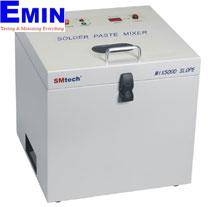
Examples in this range include the SMTech MIX500D SOLDER PASTE MIXER, the Malcom SPS-10 Solder Paste Softener, the Malcom SPS-2000 Solder Paste Softener, and the REN THANG RAM-60 High Speed Cream Mixer. For users who need to evaluate paste behavior rather than only condition it, the Malcom TK-1S Solder-Paste Tackiness Tester represents a more process-oriented measurement approach within the same application space.
Mixing, softening, and testing: understanding the differences
Not every paste preparation task is the same. A mixer is generally used to homogenize solder paste after storage, helping redistribute flux and metal particles more evenly before printing. This is useful when the goal is to reduce separation effects and prepare jars for regular production use.
A softener is more focused on restoring workable condition through controlled motion and stress, often with features such as auto-balancing, timer settings, or safety interlocks. This can be helpful where paste behavior needs to be managed carefully from batch to batch. A tackiness tester, by contrast, is not a mixer; it is used to check how the paste behaves under defined conditions, which may support troubleshooting or process validation.
Representative manufacturers and product options
Malcom is one of the key names in this category, particularly for users looking beyond basic agitation toward more process-specific paste conditioning and evaluation. Models such as the SPS-10 and SPS-2000 illustrate different approaches to solder paste softening, while the TK-1S is aimed at tackiness measurement where process data is important.
SMTech offers the MIX500D as a compact solution for mixing solder paste jars, making it relevant for workshops and production cells that need straightforward preparation equipment. REN THANG is also represented with the RAM-60 High Speed Cream Mixer, which fits the same broader need for controlled paste mixing before use.
How to choose the right solder paste mixer
The right selection depends on how your team handles paste, the container sizes in use, and whether the requirement is simple mixing or a more controlled conditioning process. Jar capacity, rotation method, speed range, timer settings, balancing features, and power requirements all influence day-to-day usability. In a busy SMT environment, ease of operation and repeatability are often more valuable than choosing a unit based only on headline speed.
It is also worth considering whether your process needs only preparation equipment or also verification tools. If print consistency is a recurring issue, a combination of mixing and process evaluation may be more useful than replacing one step in isolation. For repair and rework operations, users may also work alongside hot air rework systems or BGA rework equipment, where material handling quality still affects the overall result.
Common application scenarios
Solder paste mixers and softeners are commonly used in SMT assembly lines, electronics manufacturing cells, prototype labs, and maintenance departments that prepare paste in small or medium volumes. They are especially relevant where paste may be refrigerated before use, stored between shifts, or reused under controlled procedures. In these cases, manual stirring may not provide the same consistency or repeatability as dedicated equipment.
They can also support engineering teams during process setup, stencil print optimization, and quality investigations. When the objective is to reduce variables in paste performance, controlled preparation becomes a practical part of the workflow rather than an optional extra. This is particularly important where fine-pitch printing or stable deposition is required.
What to review before ordering
For most buyers, the main checkpoints are container compatibility, operating method, machine footprint, and whether the equipment is intended for production use or process analysis. If your paste is handled in standard jars around a few hundred grams, compact mixers may be sufficient. If your workflow requires more specific conditioning behavior, a dedicated solder paste softener may be a better fit.
It is also sensible to review how the unit fits into the broader electronics bench or SMT line. Buyers comparing process tools may also want to look at adjacent categories such as desoldering stations when planning a complete soldering and rework setup. A well-matched paste preparation system helps support more stable printing, cleaner process control, and smoother day-to-day operation.
Supporting stable solder paste handling
This category is intended for users who need a more controlled way to prepare solder paste before printing or process evaluation. Whether the requirement is compact mixing, dedicated softening, or tackiness testing, the available options cover several practical needs found in SMT production and electronics assembly.
By choosing equipment that matches your paste volume, handling routine, and process expectations, it becomes easier to improve consistency at the start of the soldering workflow. That makes SOLDER PASTE MIXER equipment a relevant part of building a more repeatable SMT process, especially where print quality and material condition need closer control.
-
-
-
-
-
-
-
-
-
-
-
-
-
-
-
-
-
-
-
-
-
-
-
-