

Signal generators
Generating repeatable electrical signals is a basic requirement in design validation, troubleshooting, production test, and education. Whether the task involves analog waveform simulation, digital timing checks, or RF source generation, the right signal generators help engineers create stable, controllable test conditions for circuits, instruments, and embedded systems.
This category brings together instruments used to produce standard and arbitrary waveforms across a wide frequency range, from low-frequency bench testing up to microwave applications. It is relevant for laboratories, electronics manufacturers, maintenance teams, R&D departments, and training environments that need dependable sources for signal injection, response analysis, and system verification.
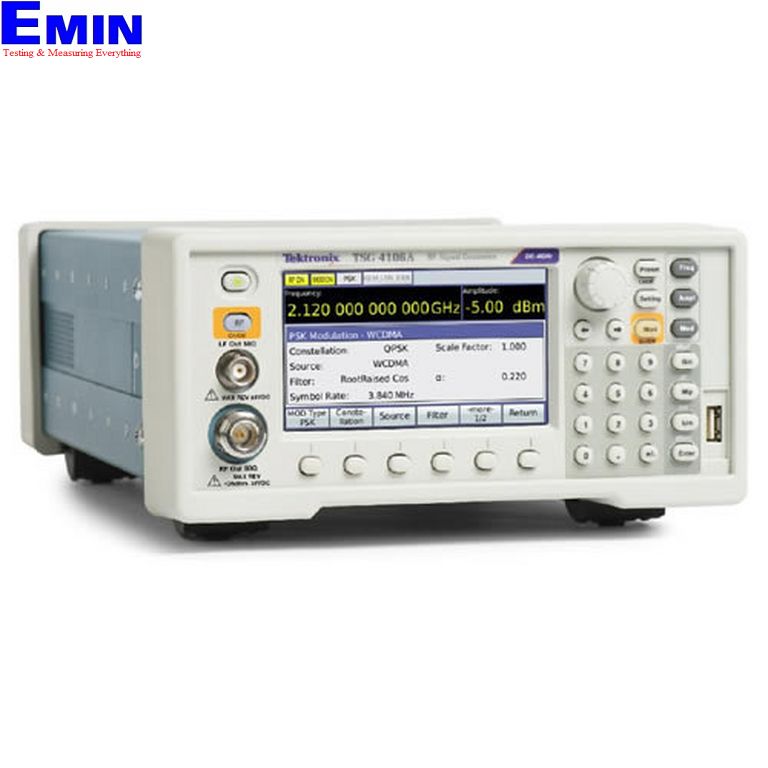
Where signal generators fit in an electronic test setup
A signal generator is typically used alongside oscilloscopes, counters, analyzers, and power measurement tools to stimulate a device under test with a known waveform. By controlling frequency, amplitude, modulation, and timing behavior, engineers can evaluate how a circuit responds under normal, stressed, or simulated operating conditions.
In practical setups, these instruments are often paired with a multimeter for basic voltage and continuity checks, while more advanced characterization may extend into source-measure workflows such as SMU semiconductor testing. This makes signal generation an important part of a broader electronic measurement ecosystem rather than a standalone tool.
Common generator types used in labs and production
The category covers several types of generators with different purposes. Function generators are commonly selected for standard outputs such as sine, square, ramp, pulse, and triangle waveforms. They are well suited to education, service benches, embedded design, and general analog or digital signal simulation.
Arbitrary waveform generators go further by allowing users to create custom shapes and replay more complex patterns. This is useful when testing real-world sensor behavior, transient events, communication patterns, or application-specific signals that cannot be represented by standard waveforms alone.
For higher-frequency work, RF signal generators and microwave-capable sources are used in wireless, aerospace, component evaluation, and receiver testing. These instruments place greater emphasis on frequency coverage, spectral purity, phase noise, output level control, and modulation performance.
Representative products in this category
Several instruments in this range illustrate the breadth of available solutions. For bench waveform generation, the KEYSIGHT 33622A Trueform waveform/function generator provides dual-channel output up to 120 MHz, making it suitable for engineers who need clean low-jitter signals and arbitrary waveform capability in a compact format. Models such as the KEYSIGHT FG33532A and FG33531A also address 100 MHz waveform generation needs in two-channel and one-channel configurations.
For entry-level or teaching environments, the KEYSIGHT EDU33212A and EDU33211A support common waveforms, modulation modes, and basic arbitrary generation in a more accessible frequency range. These types of instruments are often used for academic labs, introductory electronics courses, and routine circuit validation.
On the RF side, the KEYSIGHT E8257D PSG analog signal generator extends from 100 kHz to 31.8 GHz, showing how this category also supports high-frequency test applications. In another segment, BKPRECISION 4079C, 4079C-GPIB, and 4078C models represent arbitrary waveform generation for users who need features such as programmable output behavior, sweep capability, and instrument control options including GPIB on selected versions.
How to choose the right signal generator
The first selection factor is frequency range. A low-frequency bench application, audio test, or microcontroller-related task may only require tens of megahertz, while RF design and wireless validation demand much higher coverage. Choosing more bandwidth than necessary can add cost, but choosing too little can limit future test capability.
Next, look at channel count and waveform flexibility. Single-channel units may be enough for simple stimulus tasks, but dual-channel generators are often preferred when comparing signals, driving differential circuits, or combining clock and modulation sources. If your test method depends on replaying nonstandard patterns, arbitrary waveform memory depth and sample rate become more important than basic waveform count alone.
Signal quality also matters. Parameters such as jitter, harmonic distortion, phase noise, rise time, and amplitude accuracy affect the usefulness of the output, especially in timing-sensitive or RF applications. For automated environments, it is also worth checking trigger modes, sweep behavior, modulation support, and remote control interfaces.
Applications across industries
In product development, signal generators are used to stimulate amplifiers, filters, ADC and DAC stages, embedded boards, communication paths, and power control circuits. Engineers may inject sine waves for linearity checks, pulses for timing analysis, or custom waveforms to simulate sensor outputs and operating events.
In manufacturing and maintenance, they support repetitive test routines, fault isolation, and replacement verification. A generator can help confirm whether a board, cable path, or subsystem responds correctly when exposed to a controlled input, which is especially useful when used together with measurement tools and automated procedures.
High-frequency sources are also relevant in specialized fields. For example, RF and microwave generation may support evaluation tasks related to wireless modules, antenna paths, or systems associated with technologies such as Doppler Radar. The required performance level depends heavily on the complexity of the device under test and the precision of the measurement objective.
Accessories, upgrades, and system integration
Not every item in this category is a standalone generator. Some products support the broader test workflow through upgrades and connectivity accessories. The KEYSIGHT 335ARB1U, for example, adds arbitrary waveform capability to compatible 33500B Series instruments, which can be a practical path when users want to expand functionality without replacing the base unit.
Accessories such as the KEYSIGHT 10834A GPIB-to-GPIB adapter or the KEYSIGHT 11500A cable assembly play a different but still important role. They help integrate generators into existing racks, automated test systems, and measurement benches where space, connectivity, and signal routing can influence day-to-day usability and repeatability.
For buyers planning long-term deployment, it is often useful to consider not just the generator itself, but also the surrounding ecosystem of interfaces, cabling, and compatible accessories. That approach supports smoother installation and easier scaling in shared labs or production environments.
Brands commonly considered for signal generation
This category includes recognized manufacturers used in electronic test and measurement environments, including BKPRECISION, KEYSIGHT, ANRITSU, Rohde & Schwarz, TEKTRONIX, Aim TTI, PICO, and others listed for this range. Different brands may be preferred depending on whether the priority is classroom use, bench versatility, RF performance, software integration, or compatibility with existing lab standards.
When comparing brands, procurement teams usually focus on fit for application, available frequency classes, interface requirements, support for modulation and arbitrary generation, and how well the instrument integrates with the rest of the test environment. The best choice is generally the one that matches the actual workflow, not simply the broadest specification set.
Final considerations before purchasing
Before selecting a model, it helps to define the test objective clearly: the waveform type required, expected frequency span, number of channels, modulation needs, control interface, and whether future expansion is likely. That prevents under-specifying a source for demanding work or overbuying features that will remain unused.
Across education, product design, repair, and automated test, signal generators remain one of the most practical tools for creating controlled electrical inputs. A well-matched generator improves repeatability, shortens troubleshooting time, and supports more confident measurement results across the full electronic test workflow.
Types of Signal generators (857.000)
- Function/Arbitrary Waveform Generators (525.000)
- RF & Microwave Generators (57.000)
- RF Signal generator (271.000)
-
-
-
-
-
-
-
-
-
-
-
-
-
-
-
-
-
-
-
-
-
-
-
-