

HVAC Manifolds and Gauges
When servicing refrigeration and air-conditioning systems, stable pressure readings and reliable charging control are essential for both accuracy and safety. HVAC manifolds and gauges sit at the center of that work, helping technicians check system pressure, monitor refrigerant behavior, perform charging tasks, and evaluate operating conditions during installation, maintenance, and troubleshooting.
On this page, you can explore instruments ranging from classic analog manifold gauges to digital manifold kits with temperature measurement and app connectivity. The category is relevant for field service on split systems, commercial refrigeration, and broader HVAC maintenance where pressure, vacuum, and temperature data need to be read quickly and interpreted correctly.
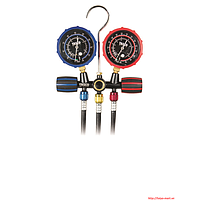
Where manifolds and gauges fit in HVAC service work
A manifold gauge set is more than a simple pressure display. In day-to-day HVAC service, it acts as a practical interface between the technician and the refrigeration circuit, supporting tasks such as pressure checking, refrigerant charging, evacuation verification, and general system diagnostics.
Depending on the workflow, users may prefer a straightforward analog setup or a more advanced digital manifold that combines pressure and temperature inputs in one device. For teams that also work with leak checking or system diagnostics, it can be useful to review related tools such as refrigerant gas detectors alongside gauge equipment.
Analog and digital options for different maintenance needs
Analog manifold gauges remain common because they are familiar, durable, and easy to use in routine field service. Products such as the TASCO TB120RS LEAK LOCK Manifold Gauge and TASCO TB140RS LEAK LOCK Manifold Gauge illustrate this practical approach, with configurations intended for common refrigerant service applications and hose-based charging work.
Digital models are often chosen when the job requires higher reading convenience, multi-unit display, or combined temperature and pressure analysis. The TESTO 550s Digital Manifold With Wireless Clamp Temperature Probes and TESTO 550s Digital manifold kit are good examples of instruments designed for technicians who want direct digital readout, clamp temperature input, and easier documentation in the field.
Another useful example is the PCE PCE-HVAC 10 Manometer, which combines pressure and temperature measurement for HVAC applications. Devices in this type of format can support faster interpretation of system conditions when technicians need to compare line pressure with pipe temperature during service checks.
Supporting tools in the same workflow
This category also includes accessories and support devices that play a direct role in charging and refrigeration service. A manifold gauge setup is often only one part of the full job; hoses, regulators, and flow control components are equally important for safe and controlled operation.
For example, the TASCO TB140RS-HOSE Hose for Manifold Gauge and TASCO TB120RS-Hose Hose for Manifold Gauge serve as connection components for refrigerant charging work. The TASCO GP500- HVAC Nitrogen Regulator and TASCO NFC Nitrogen Flow Control are relevant when nitrogen is used for purging or controlled flow tasks during HVAC installation and brazing processes. Replacement parts such as the TASCO TB14HN Pressure Gauges also matter in service environments where maintaining existing tool sets is more practical than replacing the entire assembly.
Key selection points before choosing a manifold or gauge
The right product depends on the service environment, refrigerant type, and the level of diagnostic detail required. One important factor is the measurement range. HVAC work can involve low-pressure, high-pressure, or vacuum-related checks, so the instrument should match the expected operating window of the systems being serviced.
Connection type and compatibility also matter. Some tools are built around specific fittings, hose sizes, or refrigerant use cases, while others support broader application coverage. If your jobs include newer refrigerants or mixed fleets of equipment, digital options with wider refrigerant libraries may offer a more flexible workflow than a basic analog gauge set.
Another major consideration is whether temperature input is needed. Instruments such as the TESTO 550s kits and PCE HVAC models show the advantage of combining pressure and temperature measurement in one setup. This can simplify superheat or subcooling-related evaluation and reduce the need to carry separate devices from the electrical refrigeration tools range for every basic inspection task.
Examples of instruments in this category
For users looking for a digital pressure and temperature solution, the PCE HVAC 4 Manometer offers a combination of differential pressure measurement and Type K temperature capability. In practical terms, instruments in this class can be useful when service work extends beyond basic refrigerant charging and requires additional thermal or pressure-related checks.
For refrigerant circuit service, the TESTO 550s Digital manifold kit and the version supplied with wireless clamp temperature probes represent a more integrated field setup. These products suit technicians who want pressure readings, temperature data, and easier handling during commissioning or maintenance. On the analog side, the TASCO TB120RS and TB140RS manifold gauges remain relevant choices where mechanical simplicity and conventional gauge reading are preferred.
Choosing by application instead of only by brand
Well-known manufacturers in this category include TESTO, PCE, and TASCO, each represented here by products suited to different service styles. That said, selection is usually most effective when based on actual job requirements rather than brand name alone. A light-duty service workflow, for example, may be well served by an analog manifold, while more documentation-focused maintenance may benefit from digital measurement and wireless accessories.
It is also worth considering the broader service ecosystem. If refrigerant recovery is part of your maintenance process, you may want to review refrigerant recovery devices in parallel so the gauge set, hoses, and recovery workflow align with the type of systems being handled.
Practical buying guidance for B2B users
For contractors, MRO teams, and industrial service buyers, consistency across tools can improve training, parts replacement, and day-to-day efficiency. Standardizing on a certain style of manifold, hose connection, or digital interface often reduces setup errors and shortens service time in the field.
Before ordering, it helps to confirm the required pressure range, supported refrigerants, hose and port format, and whether temperature clamps or case sets are needed. In many cases, the best fit is not the most complex instrument, but the one that matches the service procedure your team performs most often.
Final thoughts
This category brings together essential instruments for refrigeration and air-conditioning pressure work, from traditional manifold gauges to more advanced digital service tools. Whether the priority is routine charging, temperature-assisted diagnostics, or support accessories for nitrogen and hose connection tasks, a well-matched setup can make HVAC service more efficient and easier to manage.
If you are comparing options, focus on application fit, refrigerant compatibility, connection format, and the level of measurement detail required in the field. That approach will usually lead to a more practical and durable choice than selecting by appearance or product type alone.
-
-
-
-
-
-
-
-
-
-
-
-
-
-
-
-
-
-
-
-
-
-
-
-