
Multifunction I/O
When a control or test system needs to read sensors, monitor status signals, count events, and react in real time, using separate modules for every task can quickly make the architecture more complex than necessary. Multifunction I/O devices help simplify that design by bringing multiple signal types into a single hardware platform, making them a practical choice for lab automation, machine development, validation benches, and embedded control systems.
Within NI-based data acquisition and control environments, this category brings together hardware for analog measurement, timing, and mixed-signal connectivity across USB and CompactRIO platforms. It is especially relevant for engineers who need a flexible interface between physical signals and software-driven measurement or control workflows.
Why multifunction I/O is widely used in test and automation
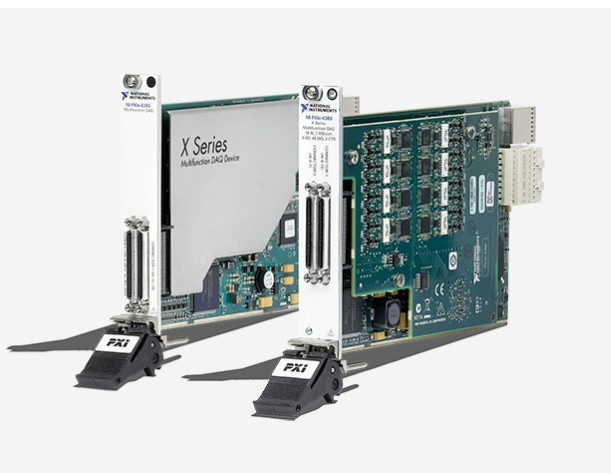
A multifunction platform is designed to handle more than one class of signal in the same system. Depending on the device, that can include analog input, digital channels, and counter or timer resources for event measurement, pulse generation, or encoder-related tasks. This combination reduces integration effort and can make both prototyping and deployment more efficient.
For many engineering teams, the main advantage is versatility. A single device may support sensor acquisition today, digital status monitoring tomorrow, and timing-based measurements later in the project lifecycle. That flexibility is useful in R&D environments, production fixtures, and academic labs where requirements evolve over time.
Typical hardware options in this category
The products shown in this category illustrate several ways multifunction I/O can be implemented. For straightforward USB-based measurement, the NI USB-6210 Multifunction I/O Device is a good example of a compact instrument for analog acquisition and timing functions in a bus-powered format. It suits applications where portability and quick PC connectivity are important.
For modular embedded systems, the NI-9381 C Series Multifunction I/O Module is available in CompactRIO-compatible versions, including a conformal coated option. This type of module fits applications where multifunction signaling needs to be integrated into a rugged controller-based architecture rather than connected as a standalone USB device.
At the higher-performance end, NI USB-7845, USB-7846, USB-7855, and USB-7856 models combine multifunction I/O with FPGA-based reconfigurable hardware. These devices are relevant when engineers need tighter control of signal timing, custom digital behavior, or deterministic processing closer to the measurement interface.
Choosing between standard DAQ and reconfigurable I/O
One of the most important selection decisions is whether a conventional multifunction DAQ device is sufficient or whether a reconfigurable I/O platform is the better fit. Standard USB multifunction devices are often well suited to general-purpose acquisition, sensor testing, and bench-level measurement where software timing and standard driver support meet the application requirements.
FPGA-based USB reconfigurable devices are more appropriate when the task involves high-speed digital interaction, user-defined timing behavior, or mixed analog and digital processing that benefits from hardware-level execution. In these cases, the USB-784x and USB-785x families offer a broader design space than a basic DAQ interface.
If the project is centered mainly on mixed analog and timing functions, you may also want to review the broader multifunction I/O range alongside more focused signal categories to compare architecture options.
Key criteria for selecting the right device
In practice, choosing multifunction I/O hardware usually starts with signal type and channel strategy. Engineers should confirm whether the application needs single-ended or differential analog inputs, whether simultaneous sampling is required, and how many timing resources are needed for counters, pulse measurements, or trigger-related tasks.
Resolution and sample rate also matter, but they should be evaluated in context. A 16-bit USB device such as the NI USB-6210 may be appropriate for many measurement tasks, while a 12-bit CompactRIO module may be completely adequate when the priority is embedded integration rather than standalone precision acquisition. Similarly, higher sample rates are useful only if the sensor dynamics and software workflow actually demand them.
Mechanical and system-level factors are just as important. USB bus-powered devices are convenient for portable or desktop setups, while enclosed versions can simplify deployment in test stations. CompactRIO-compatible modules make more sense when the I/O must become part of a distributed controller or industrial automation platform.
Applications and signal environments
Multifunction I/O is used across a wide range of engineering tasks. Common examples include reading voltage-based sensors, collecting analog feedback from prototypes, counting pulses from external devices, and coordinating digital status signals during functional test. In machine development, these devices can bridge prototype electronics with validation software before the final control hardware is frozen.
In automated test environments, multifunction hardware is often chosen because it supports multiple measurement needs without forcing the user to assemble a large stack of single-function modules. Where the application is more specialized, related categories such as voltage measurement hardware or digital I/O devices can provide a more targeted fit.
How timing and counter resources affect system design
Counter and timer functions are often overlooked during initial hardware selection, but they can be critical in real applications. Tasks such as event counting, pulse-width measurement, frequency tracking, and trigger synchronization depend on having the right timing resources available from the start. A product like the NI 783407-01 Counter/Timer Module highlights the role dedicated timing channels can play in broader measurement and control architectures.
When the application involves motion-related feedback, pulse trains, or hardware-coordinated sequencing, timing resources may become more important than raw analog channel count. In these cases, engineers should review not only the analog side of the device but also the available counters, clocking options, and interaction with other control or communication layers, including industrial communication buses where system integration requires it.
NI ecosystem considerations
This category is centered on NI hardware, which is widely used in data acquisition, test, and automation environments. For buyers already working with NI-based software or modular platforms, staying within the same ecosystem can make device integration, expansion planning, and maintenance more straightforward.
That said, the right choice still depends on application structure. A USB multifunction device may be the best answer for a benchtop setup, while a C Series module is often more appropriate for embedded deployment. Reconfigurable USB devices are valuable where custom timing and digital behavior matter. Looking at the full signal path rather than a single headline specification usually leads to a better hardware decision.
Finding the right multifunction I/O configuration
The most effective way to compare products in this category is to begin with the signals you need to acquire or generate, then map those needs to platform style, timing requirements, and deployment constraints. That approach helps separate general-purpose DAQ tasks from applications that truly need FPGA-based flexibility or controller-integrated modular I/O.
Whether you are building a compact USB measurement setup, extending a CompactRIO system, or developing a mixed-signal test platform, multifunction I/O provides a practical foundation for connecting real-world signals to software and control logic. Reviewing channel types, timing behavior, and integration needs side by side will make it easier to select hardware that fits both current requirements and future expansion.
-
-
-
-
-
-
-
-
-
-
-
-
-
-
-
-
-
-
-
-
-
-
-
-