

Digital height gauge
Accurate vertical measurement is a routine requirement in machining, inspection, and quality control, especially when parts must meet drawing tolerances consistently across batches. A digital height gauge helps simplify that task by combining the stability of a height measuring instrument with a clear digital readout, making setup and checking work faster and easier to repeat.
On this page, you can explore digital height gauge options for different working ranges, accuracy levels, and shop-floor or metrology needs. The category includes compact models for everyday inspection as well as higher-precision systems suited to more demanding measurement routines.
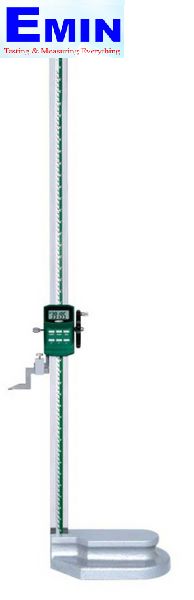
Why digital height gauges are widely used in inspection work
Compared with traditional scale-based instruments, digital models improve readability and reduce the chance of operator interpretation errors. This is especially useful in production environments where repeated checks are carried out on shoulders, steps, grooves, hole centers, or reference surfaces.
Another practical advantage is workflow speed. Operators can zero the instrument at a reference point, move through multiple features, and read values directly without relying on manual graduation lines. In many applications, that means better consistency between shifts and more efficient in-process inspection.
How these instruments fit into the measuring process
A digital height gauge is typically used on a surface plate to measure vertical dimensions from a stable reference plane. The carriage moves along the beam, and the displacement is shown on the display, allowing users to compare heights, transfer measurements, or verify dimensions against specification requirements.
In workshops and QC rooms, these gauges are commonly used for first-piece inspection, incoming part checks, and final dimensional verification. They are also useful when documentation and traceability matter, since some models support data output for recording results as part of a broader quality process.
Range, resolution, and accuracy: what matters when selecting a model
Selection should begin with the size of the parts being measured. Smaller components and bench inspection tasks may only require a 150 mm or 300 mm range, while larger fixtures or taller workpieces call for extended travel. Choosing too little range creates limitations; choosing too much may add cost and footprint without a clear benefit.
Resolution and accuracy should be matched to the actual tolerance level of the work. For example, a compact model such as the MOORE & WRIGHT MW192-20D covers 0-150 mm and is suitable where a smaller measuring envelope is enough. For standard workshop inspection, the MOORE & WRIGHT MW190-30DBL and the MITUTOYO 570-402 Digital ABS Height Gauge both sit in the common 300 mm class, which is widely used for general dimensional control.
Where larger measuring capacity is required, models like the MOORE & WRIGHT MW197-60DDL extend to 600 mm. For users comparing digital and traditional readout styles, it can also be useful to review the vernier height gauge category to understand which format better fits the inspection method and operator preference.
Examples across different measurement needs
This category covers more than one level of performance. For routine shop-floor tasks, common digital gauges in the 300 mm to 600 mm range are often selected because they balance capacity, readability, and practicality. Products from MOORE & WRIGHT in this range are typical examples for daily use in fabrication, machining, and general QA work.
For higher-end metrology applications, Trimos models such as the V1+300, V1+600, and larger V9-1100 series show how digital height measurement can scale toward greater precision, finer resolution, and broader data handling capability. Variants with steel or granite bases also indicate that instrument stability and installation conditions may play an important role in the final selection.
For buyers standardizing around established inspection brands, the MITUTOYO range is also relevant, particularly for users seeking digital readout and familiar workshop measurement workflows in a compact 300 mm format.
Key selection criteria for industrial buyers
When specifying a height gauge for B2B procurement, it helps to look beyond the display type alone. The first consideration is the measuring environment: a clean QC room, a machining area with coolant exposure, or a general-purpose inspection bench can each place different demands on the instrument.
Buyers should also evaluate base stability, ease of carriage movement, display clarity, and whether data output is needed for reporting or SPC-related workflows. Some of the Trimos models listed in this category include interface options such as RS232, which may be valuable where measured values need to be transferred into a computer-based documentation process.
- Measuring range: aligned with the tallest features or parts to be checked
- Required precision: based on drawing tolerances and process capability
- Instrument footprint: suitable for the available surface plate and workstation
- Data connectivity: useful for traceability and digital inspection records
- Operating conditions: important for durability in real production environments
Common applications in machining and quality control
Digital height gauges are often used to measure step heights, compare machined levels, set tool or part references, and inspect distance from a datum surface. In precision machining, they help confirm whether finished parts match the intended height dimensions before assembly or shipment.
They are also practical for comparative measurement tasks, where the operator sets a zero reference and then checks variation from one part to the next. In this role, a digital readout speeds up repeated checks and supports quicker decisions on whether a process remains within acceptable limits.
Choosing the right balance between everyday use and higher precision
Not every application requires the same class of instrument. A compact or mid-range digital gauge can be the right fit for routine inspection, maintenance, and production support, especially where speed and readability matter most. On the other hand, more advanced systems with finer resolution and better repeatability may be justified for calibration rooms, high-tolerance components, or larger workpieces.
The most effective choice is usually the one that matches the real inspection task: enough range for the job, enough precision for the tolerance, and enough functionality for the way data is handled in your facility. That approach helps avoid both under-specifying and over-investing.
Find a digital height gauge that fits your measurement workflow
This category brings together digital height gauge options for different capacities, operating environments, and accuracy requirements. Whether the priority is a straightforward workshop instrument or a more advanced metrology solution, the available range supports common industrial measurement tasks with clear, efficient readout.
If you are comparing models, focus on part size, required accuracy, working conditions, and whether digital output is needed in your inspection process. With the right instrument, height measurement becomes more consistent, easier to document, and better aligned with day-to-day quality control needs.
-
-
-
-
-
-
-
-
-
-
-
-
-
-
-
-
-
-
-
-
-
-
-
-