

Force gauges, Force Meter Push, Pull
Accurate force measurement is essential when you need to verify product strength, check assembly consistency, or evaluate push and pull performance during testing. In many production, laboratory, and maintenance environments, a digital or mechanical force gauge helps turn a subjective “feel” into a measurable value that can be tracked, compared, and documented.
Force gauges, Force Meter Push, Pull equipment is commonly used for compression and tension testing across quality control, material evaluation, component verification, and routine inspection tasks. This category brings together instruments and related accessories used to measure applied force in a controlled and repeatable way, whether the requirement is a light bench test or a heavier-duty setup with dedicated fixtures.
Where force gauges are used in practice
Push-pull force testing appears in more places than many buyers initially expect. Typical applications include checking button actuation force, spring performance, connector insertion and extraction force, packaging seal strength, cable pull tests, basic tensile checks, and compression measurements on small parts or assemblies.
These instruments are also useful in incoming inspection, process validation, and failure analysis. For organizations working more broadly in force and deformation measurement, related product groups such as strain gauges and strain meters can support deeper analysis when the task goes beyond direct handheld force measurement.
What to look for when selecting a force gauge
The first selection point is the measurement range. A gauge should cover the expected test force without operating too close to its upper limit during normal use. Choosing too large a range can reduce useful resolution for small-force work, while choosing too small a range may increase the risk of overload.
It is also important to review resolution, accuracy, and sampling behavior. In repetitive quality checks, clear digital display and stable readings improve operator confidence. In faster events, display update speed and peak capture capability become more relevant, especially when the force changes quickly during a test.
Environmental conditions and workflow matter as well. Battery operation, data storage, USB charging, and portability can be practical advantages for mobile inspection or shared lab use. If the testing process needs signal conversion or integration with other systems, a load cell transmitter may be useful elsewhere in the measurement chain.
Examples of instruments and accessories in this category
Several products in this category illustrate the range of use cases. The MOORE & WRIGHT MWT-8130, MWT-8140, MWT-8150, and MWT-8160 Digital Force Gauges cover applications from lower-force measurement up to higher ranges, with readable LCD displays, rechargeable power, onboard memory, and a stated accuracy of ±0.2% F.S. These characteristics are relevant for users who need a modern handheld solution for routine push and pull testing.
For example, the MOORE & WRIGHT MWT-8130 is suited to finer measurements in the 0-100 N range, while the MWT-8160 extends to 0-1000 N for heavier test requirements. Rather than focusing only on maximum capacity, buyers should match the model to the typical working range of the application so that the instrument remains easy to read and practical to use.
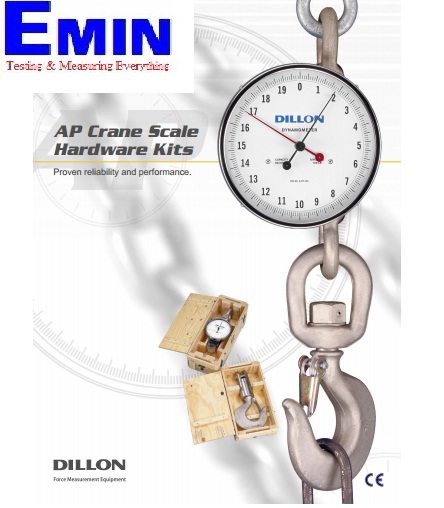
This category also includes supporting components that are important in real test setups. The DILLON 36309-0010 Puli for quick check can serve as a practical accessory in suitable force verification workflows, while KERN accessories such as the YHA-01 Hook, YSC-01 Shackle, and YSC-02 High-strength Shackle highlight how fixtures and mounting hardware affect safe, repeatable measurement.
The role of fixtures, handles, and mounting accessories
A force gauge is only part of the measurement system. In many cases, the quality of the result depends heavily on how force is transferred into the sensor. Hooks, shackles, handles, threaded adapters, and mounting accessories help align the load properly and reduce test variability caused by poor gripping or unstable positioning.
KERN accessories in this category show that even simple add-ons can be functionally important. The AFH 03 Handle, AFH 04 Stainless Steel Handle Bar, and AFH 05 Stainless Steel Handle Bar are intended to support compatibility with specific force gauge families, while the AFM 24 threaded component is relevant for certain test bench arrangements. These parts should be selected based on the instrument and fixture requirements rather than added as generic extras.
For broader setup support, some users may also need complementary peripheral devices depending on how the test station is configured. This is especially relevant when handheld measurement evolves into a more structured bench-based process.
Digital force gauges versus heavier lifting and suspended load tasks
Although push-pull force gauges and suspended load equipment both deal with force, they are not interchangeable. Handheld or bench force gauges are typically chosen for controlled testing of components and materials, while accessories such as hooks and shackles may also appear in crane-scale-related setups for specific compatible models.
Products like the KERN YHA-01 Hook and KERN YSC series shackles demonstrate that some accessories are designed for matching equipment families and capacity classes. When selecting these parts, users should confirm compatibility with the intended instrument and the expected load direction, instead of assuming any hook or shackle will fit every application.
Brands commonly considered by industrial buyers
Buyers comparing this category often review product ecosystems from established names such as DILLON, KERN, and MOORE & WRIGHT, depending on whether the priority is portable testing, compatible accessories, or practical workshop and inspection use. Other recognized manufacturers in the wider force measurement space include OMEGA, IMADA, Mark-10, Mecmesin, EXTECH, and THORLABS.
The right choice usually depends less on brand popularity and more on test method, expected force range, fixture compatibility, and how the data will be used. A simple handheld gauge may be enough for spot checks, while repetitive testing may benefit from a more structured setup with dedicated accessories and clearer data handling.
How to choose more confidently for your application
Before ordering, it helps to define a few practical points: the normal and peak force to be measured, whether the test is push, pull, or both, the required accuracy, and whether the operator needs portable use or a fixed station. It is also worth checking if the test requires only a gauge body or a complete working setup with hooks, handles, shackles, adapters, or bench-related mounting parts.
If your process involves force data alongside weighing or signal display functions in adjacent systems, related categories such as weighing indicators may also be relevant. Looking at the measurement workflow as a whole often prevents under-specifying the accessories that make day-to-day testing more consistent.
Conclusion
Choosing the right force gauge is mainly about matching the instrument and its accessories to the actual test method. Range, resolution, accuracy, overload tolerance, fixture compatibility, and ease of operation all have a direct impact on measurement quality.
Whether you are evaluating a handheld digital model such as the MOORE & WRIGHT MWT series or looking for compatible hooks, shackles, and handles from KERN, this category is intended to support practical push and pull measurement needs across industrial and laboratory environments. A well-matched setup will be easier to use, safer in operation, and more reliable for repeatable testing over time.
-
-
-
-
-
-
-
-
-
-
-
-
-
-
-
-
-
-
-
-
-
-
-
-