

Surfactants Photometers
Reliable monitoring of detergents and related compounds in water often requires more than a simple visual comparison. In routine laboratory work, environmental checks, and process control, a photometer provides a practical way to quantify low concentrations of anionic surfactants with clearer, repeatable results. This category brings together Surfactants Photometers intended for water and liquid testing applications where consistency and traceability matter.
These instruments are especially relevant when testing for anionic surfactants expressed as SDBS, helping users evaluate water quality, wastewater treatment performance, and detergent-related contamination. For teams that need a complete workflow, this category also includes compatible reagent options and portable photometer kits suited to field or bench use.
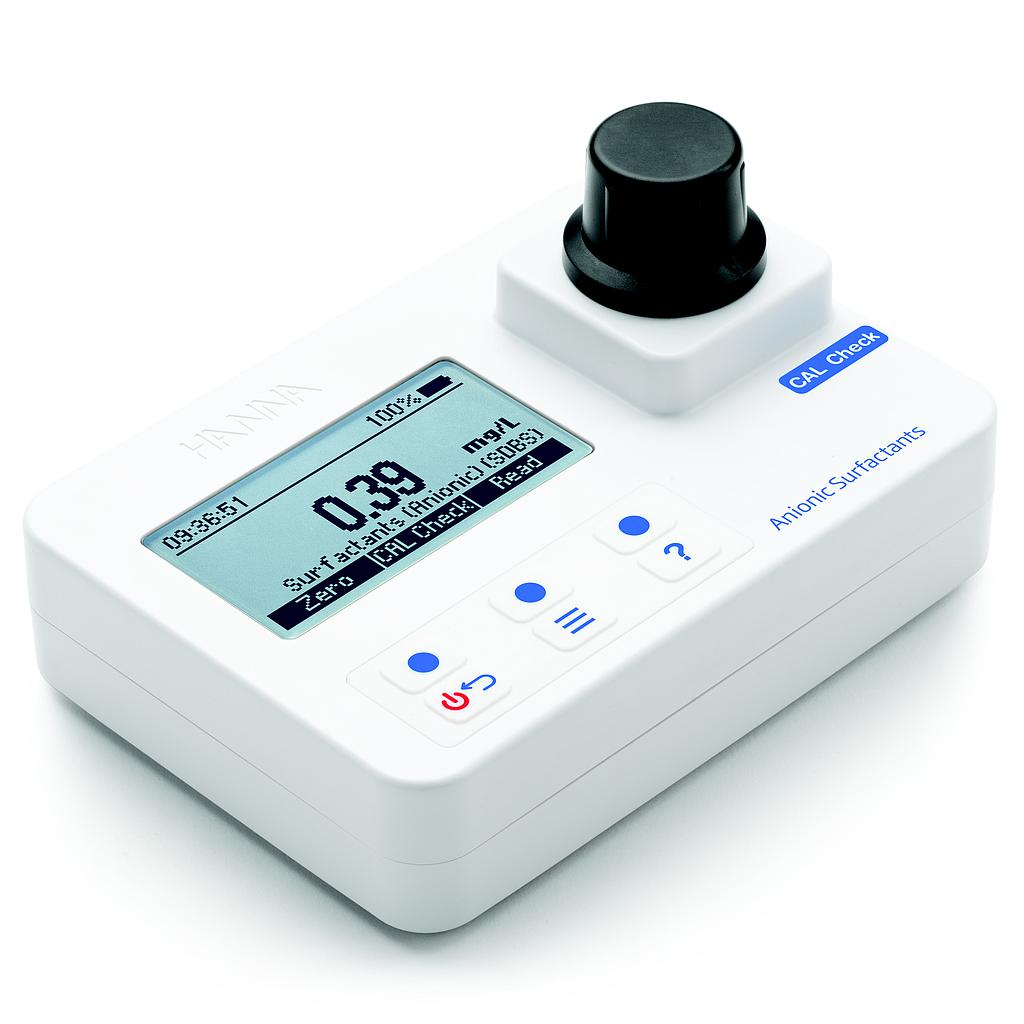
Where surfactants photometers fit in water analysis
In water testing, surfactants are commonly monitored because they can indicate contamination from cleaning agents, industrial discharge, or process residues. A dedicated photometer helps transform a color-based reaction into a numerical reading, which is useful when operators need more objective data than manual color matching can provide.
Within the broader scope of liquid testing, these instruments are typically used for anionic surfactant measurement over low mg/L ranges. That makes them suitable for applications where small concentration changes may still be operationally important, such as discharge monitoring, treatment verification, or checking incoming and treated water streams.
Typical configuration in this category
The products highlighted here focus on portable photometric measurement for anionic surfactants, including reagent support for the test method. A representative example is the HANNA HI97769 portable photometer, designed for measurement from 0.00 to 3.50 mg/L as SDBS with 0.01 mg/L resolution.
Users looking for a more complete package may consider the HANNA HI97769C portable photometer kit, which combines the instrument with accessories intended to support routine operation and verification. For ongoing testing, the HANNA HI96782-25 anionic surfactant reagents illustrate the supporting role that reagents play in keeping a photometric workflow ready for repeated use.
How these instruments measure anionic surfactants
A surfactants photometer works by reading the intensity of light passing through a prepared sample after a chemical reaction has produced a measurable color change. In this category, the method context provided is based on standard water examination practice for MBAS-type anionic surfactant testing, with measurement at 610 nm.
This approach is widely valued because it combines method structure with portable instrumentation. Instead of relying on subjective interpretation, the user prepares the sample with the appropriate reagents, places it in the cuvette, and obtains a digital result. That supports better comparison between samples, operators, and testing dates.
Selection points that matter in real use
When choosing among surfactants photometers, the first factor is the target measurement range. In this category, the available examples are intended for low-level readings up to 3.50 mg/L as SDBS, which suits many environmental and routine control tasks. Resolution and stated accuracy are also important when results may influence reporting or process decisions.
Portability can be just as important as analytical range. Instruments such as the HANNA models shown here are built around field-friendly operation, with battery power, compact form factor, and portable use in mind. Features like data logging, backlit display, and protective housing can make day-to-day work easier when measurements are performed outside a fixed laboratory setup.
Another practical consideration is the availability of consumables and maintenance items. Photometric testing is not only about the meter itself; it also depends on reagent supply, clean cuvettes, and good sample handling. If your workflow includes frequent testing, it is worth planning instrument and reagent selection together rather than treating them as separate purchases.
Portable photometer kits versus standalone instruments
For new setups, a kit version can simplify deployment because it usually groups the main instrument with essential accessories needed for startup and transport. That is useful for service teams, environmental technicians, and users building a mobile testing workflow from the beginning.
A standalone photometer may be the better fit when the site already has compatible accessories or when the buyer wants to expand an existing testing system in a more targeted way. In practice, the choice depends less on headline specifications and more on how the instrument will be used: occasional field checks, regular route-based testing, or repeated measurements at a process station.
Brand and ecosystem relevance
This category is centered on solutions from HANNA, a well-known name in portable analytical instrumentation for water testing. Here, the relevance of the brand is not just the meter itself, but the surrounding ecosystem of reagents, cuvettes, standards, and accessories that supports routine measurement.
That ecosystem matters in B2B purchasing because consistency across instrument, reagent, and maintenance items can reduce confusion during procurement and operation. Teams responsible for routine liquid analysis may also review adjacent consumable categories such as other reagents when building a broader testing workflow across multiple parameters.
Application scenarios for surfactants photometers
These instruments are relevant in a range of settings where detergent-related compounds in water need to be monitored in a structured way. Common use cases include wastewater checks, environmental sampling, industrial water monitoring, and support testing for treatment processes where surfactant residues may affect discharge quality or process stability.
They can also be valuable wherever operators need a portable method for spot checks rather than sending every sample to a central laboratory. In that context, photometers provide a balance between practicality and quantitative measurement, especially when the testing team needs fast decisions without giving up method-based analysis.
Choosing the right option for your workflow
If your priority is straightforward measurement of anionic surfactants in water, start by matching the instrument range and method to your expected sample concentrations. Then consider whether you need only the meter, a complete kit, or a reliable source of replacement reagents for ongoing testing.
For buyers comparing options, the most useful approach is to think in terms of the full testing process: sample preparation, reagent availability, portability, result recording, and routine handling of cuvettes and accessories. A well-matched surfactants photometer should fit that workflow naturally rather than adding unnecessary complexity. With the right combination of instrument and consumables, this category supports clear and repeatable surfactant analysis for professional water testing applications.
-
-
-
-
-
-
-
-
-
-
-
-
-
-
-
-
-
-
-
-
-
-
-
-