

Kalium meter
Accurate potassium measurement matters in more places than it first appears. In water and liquid testing, K+ concentration can affect process control, fertilizer management, sample preparation, and quality checks where ion balance or nutrient content must be monitored consistently. This category brings together Kalium meter solutions and related potassium testing tools for users who need dependable readings in laboratory, field, or production environments.
Depending on the application, potassium can be measured by different methods such as ion-selective sensing, photometric analysis, or refractometry. That is why this category includes not only meters, but also supporting reagents, standards, and calibration-related items that help maintain measurement quality over time.
Potassium testing methods used in this category
Not every potassium measurement task requires the same instrument type. For quick direct ion measurement in a small sample volume, a pocket-style ion meter can be practical. For colorimetric testing in defined low and medium ranges, a photometer combined with the correct reagent set is often preferred. In concentration-specific applications, a refractometer may also be relevant.
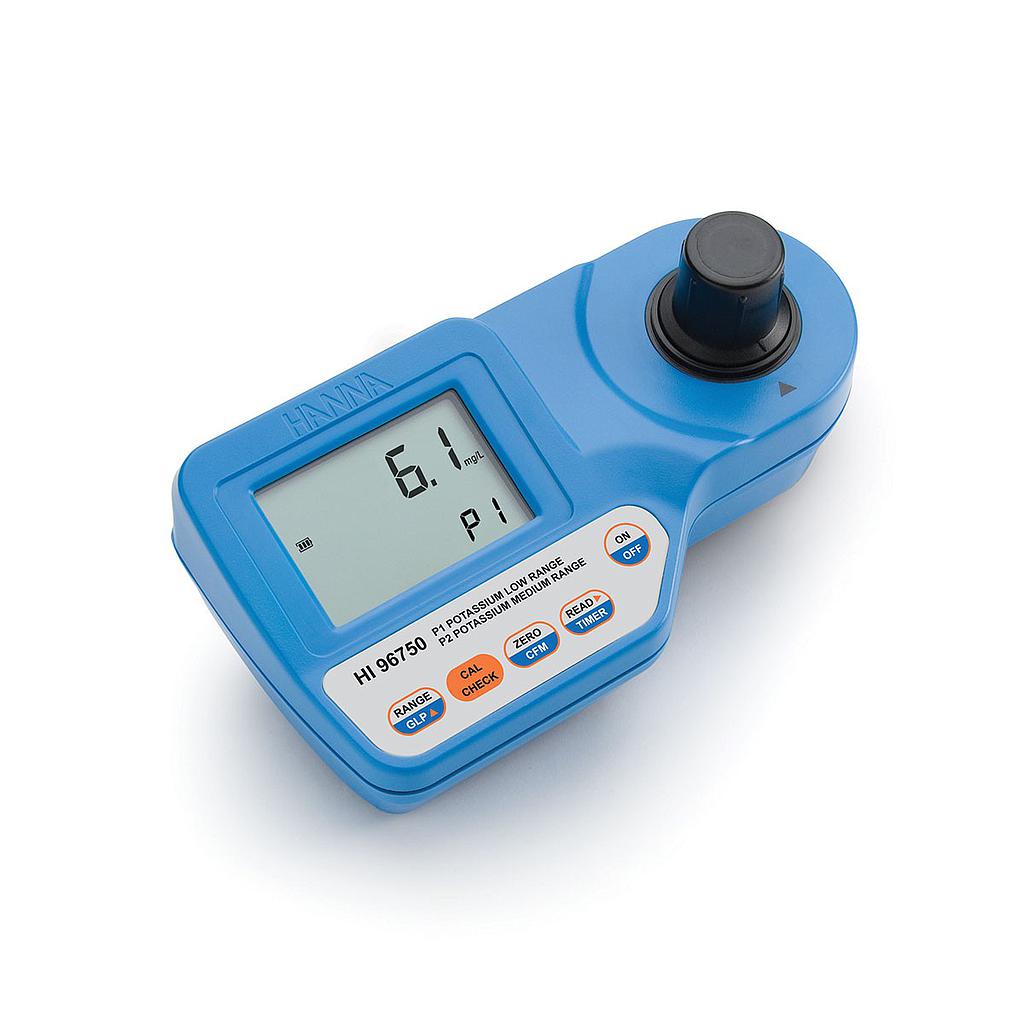
For example, the HORIBA K-11 Potassium Ion (K+) Pocket Meter is designed around an ion-selective electrode principle and is suited to direct K+ measurement. On the photometric side, HANNA offers instruments such as the HI97750 and HI96750 series for potassium low-range and medium-range analysis when reagent-based testing is the better fit.
Typical products found in a potassium measurement workflow
A complete potassium testing workflow usually involves more than the main measuring device. Users often need reagents for each test cycle, standard solutions for verification, and maintenance liquids or accessories depending on the measurement principle. Choosing the right setup means looking at the full measurement chain rather than only the meter itself.
In this category, representative products include the HANNA HI97750 Potassium Low Range & Medium Range Photometer and the HI97750C kit version, as well as the HANNA HI93750-01 and HI93750-03 potassium reagents for routine testing. For ion meter verification, HORIBA Y031L and Y031H potassium ion standard solutions provide useful support. Items such as the HANNA HI7072 electrolyte fill solution also play a role in maintaining compatible electrochemical measurement systems.
How to choose the right Kalium meter
The first selection factor is the measurement method. If you need direct potassium ion readings with minimal sample volume and portable handling, an ion pocket meter may be the most efficient route. If your workflow is based on reagent chemistry and optical detection, a portable photometer may provide a more structured process, especially when working within specified low or medium concentration ranges.
The second factor is the expected concentration range. Some applications require trace-level measurement in mg/L, while others focus on higher concentration solutions or compound-specific concentration checks. The ATAGO PAL-70S Potassium Phosphate Refractometer, for instance, fits a different use case from a K+ ion pocket meter or potassium photometer, so method suitability should always come before convenience.
It is also worth considering where the instrument will be used. Portable and water-resistant designs can be helpful for field work or production environments, while users in a controlled lab may place more emphasis on repeatability, reagent compatibility, and standard-based verification.
Applications in water, process, and nutrient-related testing
Potassium measurement is relevant in environmental and liquid analysis where dissolved ions must be monitored as part of broader quality control. This can include general water testing, process liquid checks, and nutrient-oriented measurements where potassium is one of several important parameters. In such cases, stable method selection and routine validation are often more important than simply choosing the most compact device.
Some users also work across multiple ion or chemistry parameters in the same workflow. If your testing setup extends beyond potassium, related product groups such as ion measurement electrodes or reagent products can help build a more complete analytical process.
Reagents, standards, and support items are part of measurement quality
For photometric potassium testing, reagent condition directly affects the reaction and therefore the result. Products such as HANNA HI93750-01 Potassium Reagents and Hanna HI93750-03 Potassium Reagents are not optional extras in that workflow; they are core consumables that determine whether the instrument can deliver usable data. In practice, replenishment planning is just as important as instrument selection.
Standard solutions also support confidence in day-to-day measurement. HORIBA potassium ion standard solutions such as Y031L and Y031H help users confirm response behavior in K+ testing. Where applicable, maintenance liquids like the HANNA HI7072 electrolyte fill solution support sensor operation and long-term stability. For users building a routine testing program, these supporting items should be planned from the start rather than added later.
Examples of instrument types in this category
The range of products in this category reflects different measurement approaches. The HORIBA K-11 is a compact direct-reading potassium ion meter intended for portable K+ analysis. HANNA HI97750 and HI97750C focus on low-range and medium-range potassium photometry, while the HI96750 portable photometer offers another photometric option for potassium testing with compatible reagents.
ATAGO contributes a more application-specific path with the PAL-70S Potassium Phosphate Refractometer, which is suitable when refractive index is used to assess potassium phosphate concentration. This variety is useful for buyers comparing methods based on sample type, test frequency, portability needs, and the role of potassium in the wider process.
What to review before ordering
Before choosing a product, review the sample type, required range, and whether your workflow is based on direct ion measurement or reagent-based analysis. It is also helpful to confirm the availability of consumables, calibration or standard solutions, and any accessories needed for routine use. A meter that looks suitable on paper may not fit the process if the required standards or reagents are missing from the operating plan.
Where potassium testing is part of a broader liquid analysis setup, additional quick-check tools such as test paper may be relevant for preliminary screening in certain workflows. The best choice is usually the one that matches your sample matrix, expected test volume, and maintenance capacity rather than a one-size-fits-all instrument.
Choosing with long-term use in mind
A good potassium measurement setup is not defined by the meter alone. Long-term usability depends on method fit, consumable availability, calibration support, and how easily the device integrates into your actual testing routine. That is especially important in B2B environments where repeatability, documentation, and ongoing operation all matter.
This Kalium meter category is therefore best approached as a solution set: instruments, reagents, standards, and support items working together. By comparing the available potassium ion meters, portable photometers, refractometers, and compatible consumables in context, buyers can make a more informed selection for reliable liquid testing over time.
-
-
-
-
-
-
-
-
-
-
-
-
-
-
-
-
-
-
-
-
-
-
-
-