

TOC/COD/BOD
Organic load indicators are central to wastewater monitoring, process control, and compliance reporting. When operators need to understand how much oxidizable or biodegradable material is present in a sample, TOC/COD/BOD testing provides the key data used in industrial plants, environmental laboratories, and municipal treatment systems.
On this page, you can explore instruments, reagent systems, and supporting accessories used for routine analysis of total organic carbon, chemical oxygen demand, and biochemical oxygen demand. The category is especially relevant for users comparing test workflows, selecting suitable measuring ranges, or building a more complete water analysis setup for daily operation.
Why TOC, COD, and BOD are monitored together
Although these parameters are often discussed side by side, they do not measure exactly the same thing. COD indicates the amount of oxygen required to chemically oxidize substances in water, while BOD reflects the oxygen consumed by microorganisms during biological degradation. TOC, by contrast, focuses on the amount of organic carbon present in the sample.
Because each indicator highlights a different aspect of water quality, the choice depends on the application. COD is widely used for faster process decisions, BOD remains important when evaluating biological treatment performance, and TOC is valuable where direct carbon quantification and low-level organic contamination matter. In practice, these measurements help users assess influent load, treatment efficiency, and discharge condition with better context than a single number alone.
Common testing workflows in wastewater and water analysis
For many laboratories and treatment facilities, COD is the most practical routine test because it offers relatively fast turnaround compared with BOD. A typical workflow may involve sample digestion in a heater, followed by photometric reading with a compatible instrument and the use of pre-dosed reagent vials matched to the expected concentration range.
BOD testing is slower because it depends on biological activity over several days, but it remains useful when treatment engineers need data that more closely reflects biodegradation behavior. TOC analysis is often selected where speed and carbon-specific measurement are priorities, especially in controlled laboratory environments or applications requiring tighter organic contamination tracking.
How to choose equipment in this category
Selection usually starts with the required method, sample throughput, and concentration range. If the goal is routine COD monitoring in water and wastewater, users often look for a combination of photometer, digestion heater, reagent vials, and standard solutions for verification. If pH measurement is also part of the workflow, a multiparameter platform can simplify bench space and operator handling.
Range is another practical factor. Low-range reagent systems are more suitable for cleaner or treated samples, while medium- and high-range options fit stronger wastewater streams. Where very high organic loads are expected, checking compatibility between the instrument and the reagent range is essential before purchase.
For labs that also maintain broader wet-chemistry routines, related consumables such as other reagents can help complete the testing workflow without switching between multiple sourcing channels.
Representative products and system components
Within this category, several products illustrate how a complete COD-oriented setup is typically organized. The Hanna HI83399-02 Water & Wastewater Multiparameter and the HANNA HI97106 Water & Wastewater Multiparameter combine COD photometric capability with pH measurement, which can be useful in routine water and wastewater analysis where more than one parameter is checked on the same sample stream.
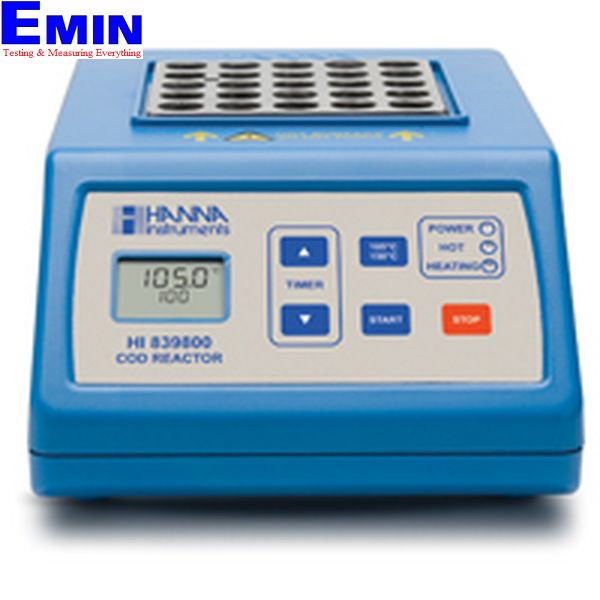
For dedicated digestion steps, the HANNA HI839800-02 COD Test Tube Heater and HANNA HI839150-02 COD Test Tube Heater support the thermal reaction stage required in many COD methods. Reagent selection then depends on expected sample concentration, with examples including HANNA HI93754A-25 for low range, HI93754B-25 or HI93754E-25 for medium range, and HI93754C-25 or HI93754J-25 for higher concentration levels.
Supporting items also matter in day-to-day operation. The HANNA HI93754-12 standard solution is relevant for verification and quality control, while the HANNA HI740217 safety sheet supports safer handling when working with sample tubes during preparation or breaking steps. In a practical lab environment, these accessories contribute to consistency and safer routine use rather than acting as standalone core instruments.
Brands commonly considered for TOC/COD/BOD applications
Users comparing solutions in this category often evaluate product availability, method familiarity, and workflow compatibility by manufacturer. Well-known names in this field include HACH, Buchi, YSI, HANNA, KYORITSU, WTW, and Aqualabo, with each brand typically associated with different strengths across laboratory analysis, process monitoring, or portable testing contexts.
In the featured products shown here, HANNA is especially visible through its COD photometers, reagent vials, heaters, and standard solutions. That makes this category useful for buyers looking for not only a single instrument, but also the surrounding consumables and accessories needed for a working analytical workflow.
Good sampling and method control are just as important as the instrument
Reliable results depend on more than the analyzer alone. Sample preservation, timing, contamination control, and correct method execution all affect the usefulness of TOC, COD, and BOD data. This is particularly important for BOD, where biological conditions can influence the result significantly, and for COD, where digestion and reagent handling need to be consistent from test to test.
For process monitoring, fast and repeatable methods are often favored because they support timely operational decisions. That is one reason COD is widely used in wastewater treatment plants and industrial discharge control. Even so, users should always match the chosen method to the reporting requirement, internal quality procedure, and actual sample matrix rather than selecting equipment on range alone.
Where these measurements fit in a broader water testing setup
TOC/COD/BOD analysis rarely exists in isolation. In real facilities, these measurements are commonly reviewed alongside pH, conductivity, dissolved oxygen, and other chemical indicators to build a fuller picture of treatment performance and discharge quality. Multiparameter instruments can help streamline this work where routine monitoring is frequent.
Some laboratories may also need supplementary tools for quick screening or sample preparation depending on their workflow. For simple field or bench checks, products such as test paper may complement instrumental analysis in broader water testing programs, even though they serve a very different level of accuracy and purpose.
Choosing the right category for your application
This category is intended for buyers who need a practical route to measuring organic load indicators in water and wastewater samples, whether for routine plant control, laboratory testing, or compliance-related work. From multiparameter photometers and COD heaters to reagent vials and verification solutions, the available products support both individual replacement needs and more complete testing setups.
If you are selecting equipment for a new workflow, it is usually best to start with the method requirement, expected concentration range, and daily sample volume. That approach makes it easier to narrow down the right combination of instrument, consumables, and accessories for dependable water quality analysis without overcomplicating the system.
-
-
-
-
-
-
-
-
-
-
-
-
-
-
-
-
-
-
-
-
-
-
-
-