

Grass and Straw moisture meters
Reliable moisture control is one of the most practical ways to protect hay, straw, and similar agricultural materials during storage and handling. Even when the surface looks dry, moisture can remain deeper inside the bale or compressed layer, creating conditions for heating, mold growth, quality loss, and in severe cases, fire risk. That is why professionals in farming, feed production, storage, and agricultural trading often rely on dedicated measuring instruments rather than visual inspection alone.
Grass and Straw moisture meters are designed for this type of task. They help users check moisture content inside hay and straw with probes or lances that can reach below the surface, and some models also support temperature measurement to identify developing hot spots. For routine agricultural checks, this category also complements broader solutions in agricultural moisture measurement.
Why moisture testing matters in hay and straw storage
Dry-looking material is not always safely stored material. In hay and straw, moisture trapped in the core can support microbial activity, which gradually raises internal temperature and accelerates deterioration. This can reduce feed value, affect color and texture, and create problems during transport or warehousing.
Moisture testing is especially important when working with baled hay, compressed straw, or bulk material that has dried unevenly. Measuring multiple points with a dedicated probe gives a more realistic picture of the batch than checking only the outside layer. In many operations, this is a simple but effective step to reduce spoilage and improve consistency before storage, sale, or processing.
Typical devices found in this category
This category includes handheld meters built specifically for hay and straw, as well as related temperature measuring devices used to monitor stored material. A good example is the PCE HMM 100 and PCE HMM 200, both intended for hay moisture measurement with lance-based sampling. These instruments are suitable when users need direct readings inside bales or stacked material rather than only on the surface.
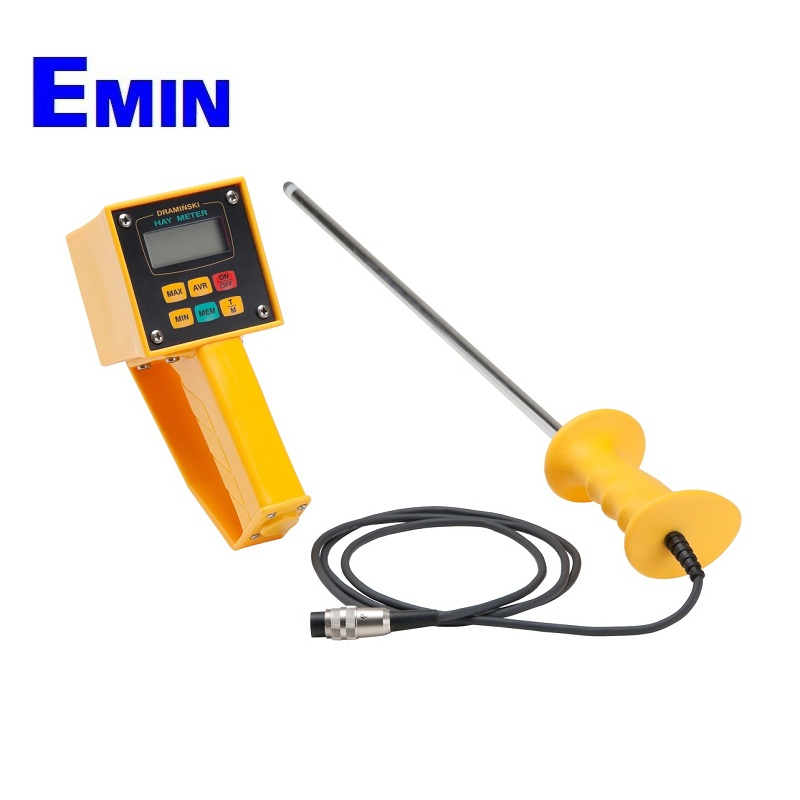
There are also hay and straw testers from DRAMINSKI, including the DRAMINSKI HMM, HMM 2M, and HMM FIX, along with replacement probes such as the HMM GLO and HMMGLO 2M. In addition, Senseca ECO 120-HayTemp models are focused on hay temperature monitoring, which can be useful when overheating is a concern during storage.
Moisture measurement and temperature monitoring work together
In practice, moisture and temperature are closely related in stored forage. If hay or straw is put into storage before it has dried sufficiently, biological activity can begin inside the packed material and internal temperature may rise. This is why many users do not stop at moisture readings alone, especially when handling large bales or dense stacks.
Devices such as the Senseca ECO 120-HayTemp series are intended for temperature checks in hay, using a fiberglass probe to reach deep into the material. Combined with moisture instruments like the PCE HMM series or DRAMINSKI HMM meters, temperature monitoring helps identify whether a batch is simply variable in moisture or already developing a heat problem that needs immediate attention.
Key selection points for buyers
When choosing a meter for this application, the first factor is usually probe length. Deeper measurement is important when testing compact bales, large bundles, or stacked material where the outer layer dries faster than the center. In this category, examples include short and extended probe formats, as well as detachable probe versions for more flexible field use.
Another important point is the required measurement range. Some users need a meter for routine drying control within a moderate moisture band, while others prefer a wider range for variable conditions or compressed straw. Temperature display, automatic compensation, reading resolution, portability, and battery-powered operation can also matter in day-to-day work. If your process involves different materials beyond hay and straw, a multifunction moisture meter may be worth comparing.
Examples of instruments in the range
PCE offers hay moisture meters such as the PCE HMM 100 and PCE HMM 200, both designed for direct insertion into the material and suitable for practical spot checks in storage and field conditions. Their design direction fits users who want a dedicated handheld unit with lance-based measurement and additional temperature indication.
For wider moisture ranges, DRAMINSKI HMM models are commonly used for hay and compressed straw testing, with versions available in fixed or detachable probe configurations. The DRAMINSKI accessory probes in this category are also relevant for maintenance or replacement in existing setups. For quick hay-focused readings, the G-WON GMK-3308 is another example of a dedicated instrument built around straightforward operation.
Good measurement practice for more reliable results
Even a capable meter will only be useful if it is applied correctly. In hay and straw, moisture may vary across the same bale depending on density, drying conditions, and storage history. It is therefore better to test several points rather than rely on a single reading, especially when deciding whether material is ready for long-term storage or shipment.
Users should also remember that measuring immediately after drying or exposure to sun can give misleading impressions if the core has not stabilized. A practical routine is to check representative locations, compare moisture and temperature where relevant, and repeat measurement on batches that show inconsistent results. For other field-related materials, separate tools such as a soil moisture meter serve different purposes and should not be treated as interchangeable with hay or straw testers.
Who typically uses grass and straw moisture meters?
These instruments are relevant for farms, forage producers, straw suppliers, livestock operations, agricultural warehouses, and traders handling baled material. They are also useful in receiving inspection, where objective readings help reduce disputes over product condition and support clearer quality checks before acceptance or resale.
Because this category includes both moisture meters and hay temperature devices, it supports several stages of the workflow: drying verification before baling, spot checks during storage, monitoring of compressed material, and condition assessment before transport. The right selection depends on whether the main need is moisture confirmation, temperature surveillance, or a combination of both.
Choosing the right tool for your workflow
The best fit usually depends on material format, inspection depth, and how often measurements are taken. If you mainly need to confirm moisture content in hay or straw, a dedicated handheld tester with the right probe configuration is typically the most practical option. If stored forage is already packed and there is concern about heat buildup, a specialized hay temperature device can add an important layer of monitoring.
This category brings together instruments from manufacturers such as PCE, DRAMINSKI, Senseca, and G-WON for real-world hay and straw inspection tasks. By matching probe style, measuring range, and field usability to your process, it becomes easier to build a safer and more consistent storage routine.
-
-
-
-
-
-
-
-
-
-
-
-
-
-
-
-
-
-
-
-
-
-
-
-